Free implementation guide / 09
Evaluate an Affiliate Business Before Depending on It
Look beyond the headline commission to channel rules, reversals, dependency and the economics you control.
A partner-dependency and unit-economics review.
Current program terms, commission conditions and a proposed acquisition route.
Jump to the working checklist ↓
Aaron Peden
Founder & CMO · Practical business education
The outcome
Complete a practical dependency review and decide what evidence you need before relying on an affiliate income stream.
This playbook is general educational guidance. The worked example is hypothetical, not a claim about Aaron’s personal results.
01Understand what earns a commission
Read the current program terms. Identify the qualifying event: a lead, approved sale, activated account or retained customer. Record exclusions, payout timing, minimum thresholds and what can reverse a commission. A quoted amount per deal is not the same as money collected.
Separate gross commissions, collected commissions, acquisition expenses and net business results. Do not annualize a few successful days. Ask for written clarification where the terms are ambiguous rather than building a forecast around the most generous interpretation.
02Check permitted acquisition channels
List the channels you intend to use: organic search, paid search, social content, email or direct outreach. Check brand bidding, domain naming, ad copy, disclosure and landing-page restrictions. Permission for one channel does not establish permission for another.
Save the version and effective date of the terms you reviewed. Establish how changes are announced and how quickly you must comply. Do not attempt to evade restrictions with alternate accounts or misleading pages. A channel you cannot use is not a growth plan.
SEE THE ACTUAL EXAMPLE
Put the relationship where readers can see it
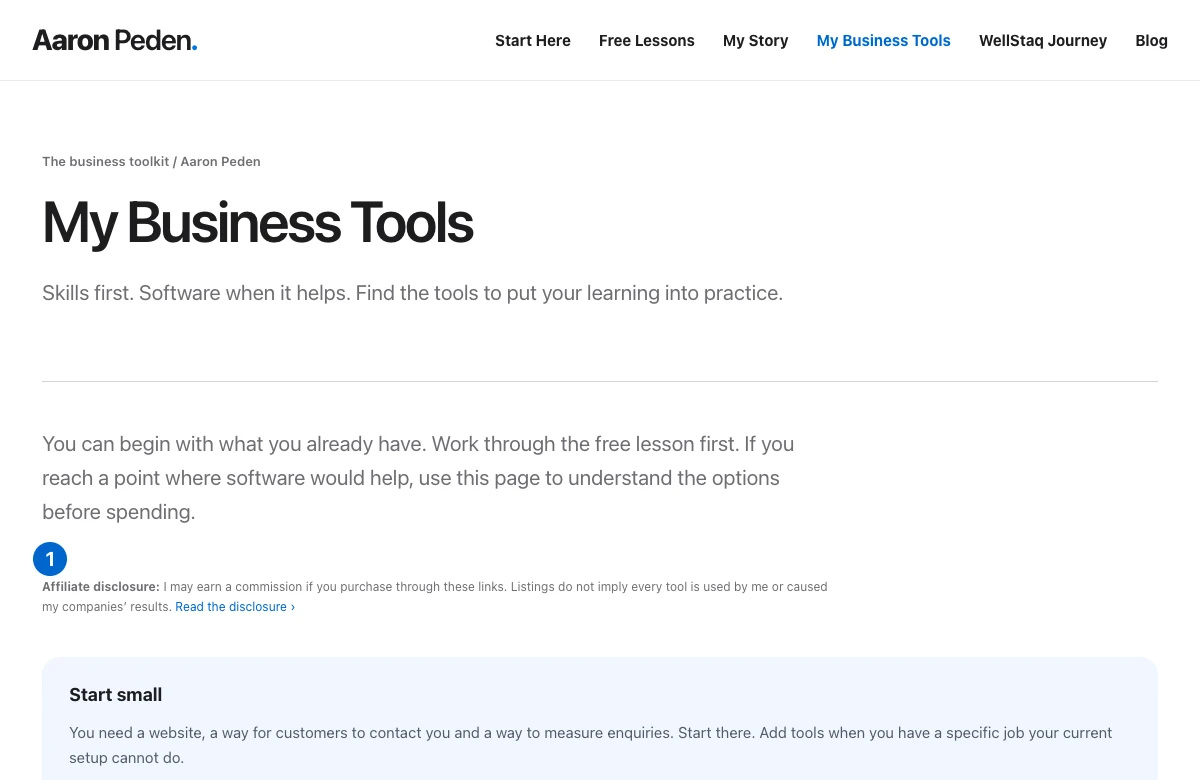
Your action: Disclose your relationship before readers act, and compare fit, limitations and a lower-cost alternative.
03Model reversals and timing
Use collected, approved commissions when evaluating results. Model at least a base and a downside case for conversion, cancellations and acquisition costs. Keep the accounting period and customer cohort consistent.
If payouts arrive after advertising bills, calculate the cash you must fund while waiting. A profitable-looking commission schedule can still create a cash gap. Do not count pending commissions as available operating cash.
04Map what the partner controls
The partner may control pricing, approval, customer service, product availability, tracking rules and payout timing. Record which changes would undermine your business and what you would do if they occurred.
Ask what assets you can retain legitimately: your original educational content, your domain, your permitted customer relationships and your operating knowledge. Do not assume you own customer data or can transfer it. Review the actual agreement and applicable obligations.
05Set a concentration limit and an exit plan
Decide how much of your time, cash and income can depend on one program. Your limit should reflect your situation, not an invented universal percentage. Consider whether alternatives are truly independent or exposed to the same supplier and policy risks.
Build a plan for paused tracking, changed terms, delayed payment or program closure. Preserve truthful disclosures near paid links and explain conflicts of interest. Recommend a product because it fits the reader’s problem, not because it pays the largest commission.
Worked example — hypothetical
A hypothetical program lists a $100 commission per approved sale. Twenty tracked sales with a 20% reversal rate produce sixteen approved sales, or $1,600 in commissions. If acquisition costs are $900, $700 remains before overhead and tax. A sixty-day payout delay still creates a funding need. If a channel used for half the sales is later disallowed, the prior forecast must be rebuilt. These figures are illustrative and are not Aaron’s results.
Download the printable worksheet ↓
The worksheet opens in a browser and can be printed or saved as PDF. No email address is required.
Common mistakes
- Treating the listed commission as take-home profit.
- Assuming channel permissions will stay unchanged.
- Confusing a tracking dashboard with paid cash.
- Depending on one partner without a disruption plan.
Your next action
Review one program’s current written terms. Mark each unknown and resolve the material questions before committing more money.
- 01Choose the reader’s job
Start with a real problem.
- 02Evaluate the options
Compare fit, limits and alternatives.
- 03Disclose the relationship
Place the disclosure beside the recommendation.
- 04Use approved links
Verify the destination and commercial terms.
Make the idea concrete.
A hypothetical $100 commission with a 20% reversal rate has an expected $80 before acquisition costs and tax. Spending $60 leaves $20 before other costs. A payout delay can still create a cash gap even when the expected unit contribution is positive.
Done means verified.
Check each item as you verify it. Progress stays in this page; download your checklist before leaving.