My Marketing Blueprint / The complete build order
My Marketing Blueprint: Build the Systems That Attract, Convert and Keep Customers
The practical build order for my marketing blueprint: fifteen connected systems, clear evidence checks, a free readiness worksheet and the technical lessons to put each part to work.
By Aaron Peden · Published · Updated October 27, 2026
THE BUILD ORDER / FROM TRAFFIC TO RETENTION
You do not need fifteen tools. You need one customer journey that works—and a way to see where it breaks.
Learning digital marketing and building systems helped our teams grow Rocktomic and YourPeptideBrand. The useful lesson is the sequence of work: make the offer understandable, measure the outcome, attract the right people, and deliver what you promised.
This is the practical walkthrough of my Marketing Blueprint Checklist. I have grouped its twelve marketing systems into a build order and added the AI setup, onboarding and retention checks retained in the wider company blueprint. The examples and sequence below explain how to apply it; they are not an audit claiming every system is deployed or profitable at any company.
If you are starting with limited time or money, choose the next constraint. Build that part, verify it, and move forward with evidence. You can use the free worksheets here without buying a subscription.
Before step one: define the business result
Write one measurable outcome for the next ninety days, the customer who matters, and the current constraint. Assign marketing, sales and reporting owners. Check delivery capacity before trying to create more demand. A goal without a period, owner and evidence source cannot guide a reliable review.
Map the journey as enquiry → qualified conversation → paying customer → activated customer → retained customer. Your business may use a different path; define it explicitly. Record qualified leads, new customers, close rate, CAC, contribution after acquisition, cash received net of refunds, activation and retention where applicable. Keep consistent periods and currencies. Unknown means the evidence is incomplete—not that the number is zero.
Follow the build order: start at step 1, use the linked technical lesson when you need it, then return here and continue to the next system. Finish by recording your evidence in the assessment.
Start step 1 →Already building? Assess your next constraint →1. Web design and sales funnels: make the next action obvious
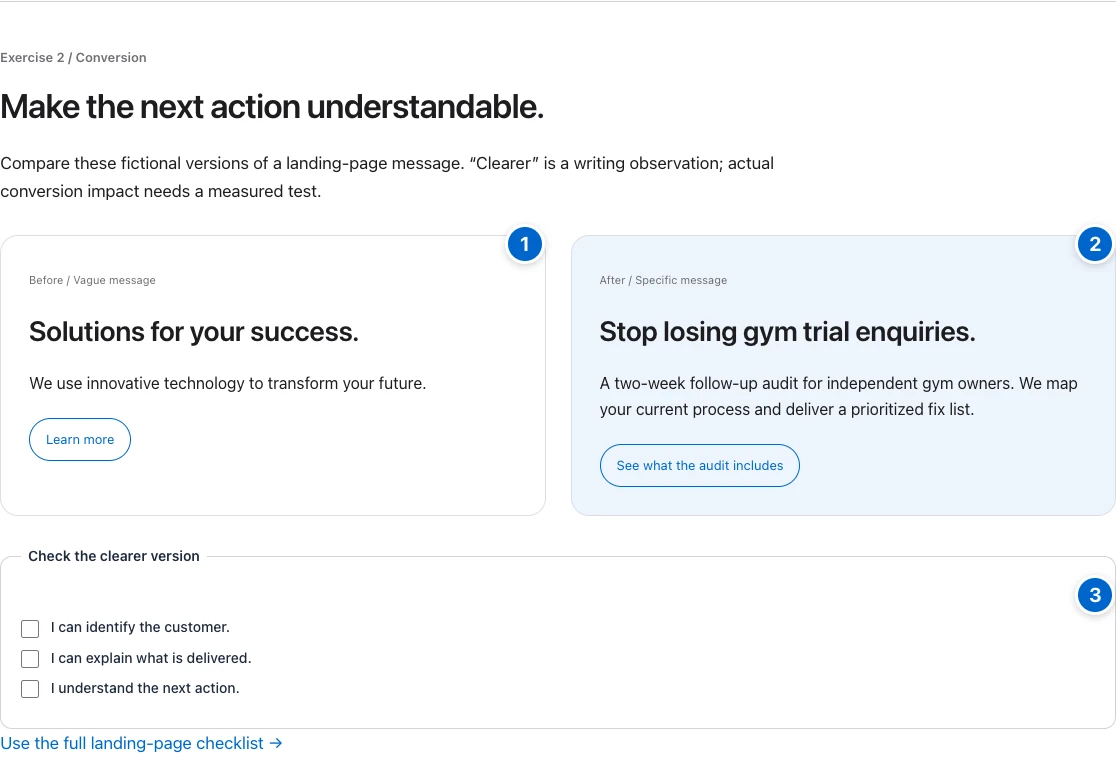
Build this: One page that answers one buyer’s question and delivers the promised next step.
Start with one customer, one problem and one offer. Write the deliverable, scope, price or pricing process, customer responsibilities and the next action. Then build the shortest useful path from the source of traffic to that action. A homepage, a service page and a checkout do different jobs; do not force every visitor through the same generic destination.
Test the page at phone width and with a keyboard. Submit fictional data in a safe environment and confirm the enquiry reaches its intended destination. Also test missing fields, rejection, slow responses and repeated clicks. A confirmation message is not enough if the record never arrives. Save the test result and the page version before moving on.
Verify it: Ask someone to explain who the offer is for, what they receive and what happens after they click. If they cannot, fix the message before adding traffic.
Follow the complete implementation lesson →
Make the offer understandable
2. Attribution: measure the business event, not the button
Build this: A documented connection between acquisition activity, accepted enquiries and customers.
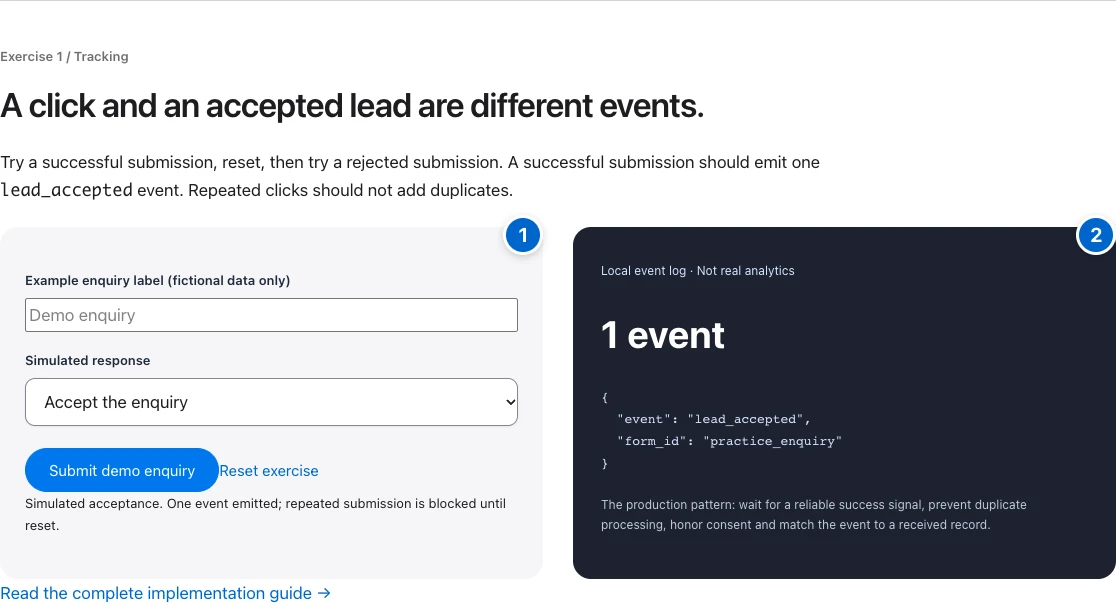
Define attempts, accepted enquiries, qualified opportunities and paying customers separately. Choose the system that can establish each state: the backend confirms receipt, sales qualifies the opportunity, and payment records establish the transaction. A browser click cannot prove all three.
Use consistent source labels and periods, then reconcile the reports. Keep personal details out of analytics parameters and campaign URLs. Consent, blockers and processing rules can make analytics differ from the backend, so document those limits rather than forcing every number to match. Attribution is a model of observed touchpoints, not certainty about every cause of a sale.
Verify it: Run accepted, rejected and duplicate-submission cases. Confirm the intended event and the received business record separately.
Follow the complete implementation lesson →
Verify the accepted outcome
3. Lead magnet: solve one problem before asking for more
Build this: A useful asset with a working delivery path and a relevant next lesson.
Choose a small task that your intended customer already wants to complete. A checklist, calculator, audit template or worked example can be more useful than a long ebook. Promise an output: a tested form, a clear offer brief or a calculated acquisition ceiling. Make the asset useful even if the reader never buys anything.
If you ask for an email address, explain what will be delivered and what additional communication the person is choosing. Do not silently turn an asset request into permission for unrelated promotions. Test the form, download or email delivery, mobile access and any unsubscribe path. You can also provide the asset without an email gate, as this site does for its worksheets.
Verify it: Give the asset to someone in the intended audience and ask them to complete the task. Record where instructions fail.
Follow the complete implementation lesson →
4. AI VSLs and explainers: demonstrate the offer without inventing proof
Build this: A clear explanation that shows the real workflow and accurately states its limits.
Write the explanation before choosing a voice, avatar or video generator. Cover the buyer’s problem, the deliverable, evidence, boundaries and next step. Show the actual interface or process where it matters. For a prototype, say prototype. For a simulated exercise, say simulation. Do not let polished production imply a mature product or a measured result that does not exist.
AI can assist with structure, voice or editing, but it must not fabricate customer endorsements, expert approval or performance evidence. Use authorized assets and review claims. Watch the finished video with sound off, review captions for numbers and technical terms, and check whether a new viewer can explain the offer after watching.
Verify it: Publish only after the visible demonstration, narration and landing-page promise agree.
Follow the complete implementation lesson →
5. Text and email sequences: continue the conversation responsibly
Build this: A permission-aware follow-up sequence tied to the customer’s actual stage.
Map the trigger, intended recipient, message, next action and stop conditions for each sequence. A requested download, booked call, abandoned checkout and active customer need different messages. Write useful follow-up around the task rather than sending the same promotion repeatedly. Stop or reroute when someone replies, purchases, unsubscribes or becomes ineligible.
Verify authentication for the sending route and test the received message, links and suppression. SMS has its own consent, identification, opt-out and carrier/platform requirements; an email subscription is not blanket permission to text. Do not import purchased contacts into a permission-based flow and assume a platform will make the practice appropriate.
Verify it: Use a test contact you control. Verify entry, delivery, reply handling, unsubscribe and exclusion from the next send.
Follow the complete implementation lesson →
6. Autoblog and content operations: automate the process, retain editorial ownership
Build this: A repeatable publishing workflow that produces original, checked answers.
The checklist calls this “Autoblog Setup.” I treat that as a content operation, not permission to generate a large volume of unreviewed pages. Begin with real customer questions, assign a distinct job to each URL and create a brief with sources, steps, screenshots, an application asset and an acceptance check. Improve an existing answer before publishing a duplicate.
Automate useful repetitive work such as routing a draft, checking a link or preparing a review queue. Keep a named editor responsible for factual claims, technical instructions and publication. AI output can invent controls, citations and outcomes. Test the instructions and retain the evidence packet. A published article is not automatically indexed, useful or commercially effective.
Verify it: Have someone follow the draft in a safe environment. Fix every missing prerequisite, unsupported claim and broken step before publishing.
Follow the complete implementation lesson →
7. Cold email: qualify the audience before scaling outreach
Build this: A relevant, compliant prospecting process with suppression and clear stop rules.
Separate prospect research from permission-based email marketing. Identify a narrowly suitable business audience and a real reason your offer may help. Confirm the contact method is appropriate under applicable law and provider rules. A publicly visible address is not universal permission to add someone to every automated sequence. Avoid fabricated personalization and claims about a prospect’s business that you have not verified.
Write a short, honest message explaining the fit and a reasonable next step. Set follow-up and stop conditions, honor objections and suppression, and record qualification outcomes. A verification tool can help assess an address but cannot guarantee delivery, consent or business fit. Do not mistake sent volume for meaningful conversations.
Verify it: Review a small approved sample for relevance, identity accuracy, message truthfulness and suppression before authorizing broader activity.
Follow the complete implementation lesson →
8. AI YouTube and social publishing: show one useful task
Build this: A repeatable video or post format that teaches something a viewer can reproduce.
Choose one question, then plan the opening result, starting state, exact actions, failure case and next lesson. Use real demonstrations where the task depends on a screen. AI can help organize a shot list or produce captions, but it should not replace the actual output with a fabricated software screenshot. Remove private tabs, credentials and customer information before recording.
Package the lesson accurately with a task-specific title, readable thumbnail and checked captions. YouTube’s guidance places more importance on title, thumbnail and description than on tags. Do not build a publishing strategy around tag stuffing or assume a particular posting frequency guarantees reach. Test whether someone can follow the lesson before judging it only by views.
Verify it: Watch the published version on a phone with captions. Ask a viewer to repeat the task without your help.
Follow the complete implementation lesson →
9. AI outreach: assist the research, keep the claims accountable
Build this: A source-backed prospecting brief with human review before contact.
Give an AI tool only material you are authorized to use. Ask it to separate verified facts, hypotheses and unknowns. Require a source for each factual personalization claim, then open the source yourself. Do not let an inferred interest, role or revenue number become a confident statement in an outreach message.
Keep a review queue and an owner. Apply contact eligibility, suppression and platform rules before sending. Limit the first test and inspect the actual replies and qualification outcomes. AI can accelerate a poor process as easily as a good one; the useful goal is better fit and less wasted work, not an unattended increase in message volume.
Verify it: Check the evidence behind each personalized sentence. Remove anything you could not defend to the recipient.
Follow the complete implementation lesson →
10. Affiliate setup: make recommendations deserve trust
Build this: A recommendation process based on reader fit, transparent relationships and issued links.
For content-led businesses, begin with the reader’s job and compare options using consistent criteria: fit, limitations, required plan, setup, exportability and a lower-cost alternative. Distinguish hands-on testing from public-documentation research. Do not claim that a product powered your company’s growth simply because you have an affiliate account.
Use only approved, issued links, disclose the relationship near the recommendation and qualify paid links appropriately. Check the destination and changing product terms. For a business running its own affiliate program, separately define eligibility, permitted claims, attribution, approval, fraud controls and payment terms. Joining someone else’s program and operating your own are different projects.
Verify it: Click every link, read every claim beside it and confirm the disclosure is visible before the reader acts.
Follow the complete implementation lesson →
11. Ads: amplify a verified path within a bounded test
Build this: A campaign brief tied to buying intent, reliable measurement and affordable economics.
Choose one intent, one offer and a destination that answers the promise. List initial keyword or audience themes, obvious mismatches, the accepted conversion, budget controls and a review rule. Check the landing page and the received enquiry path before spending. Advertising a broken journey produces costly confusion rather than a useful experiment.
Calculate contribution and acquisition cost using a consistent cohort. A cheap lead can be expensive if it rarely becomes a suitable customer. Google’s daily budget is generally an average, not a hard daily cap; inspect current platform guidance and applicable controls. Assign a person to monitor, pause and reconcile spend. A worksheet limit does not enforce itself in an ad account.
Verify it: Review accepted enquiries, qualified opportunities, paying customers and contribution separately before increasing exposure.
Follow the complete implementation lesson →
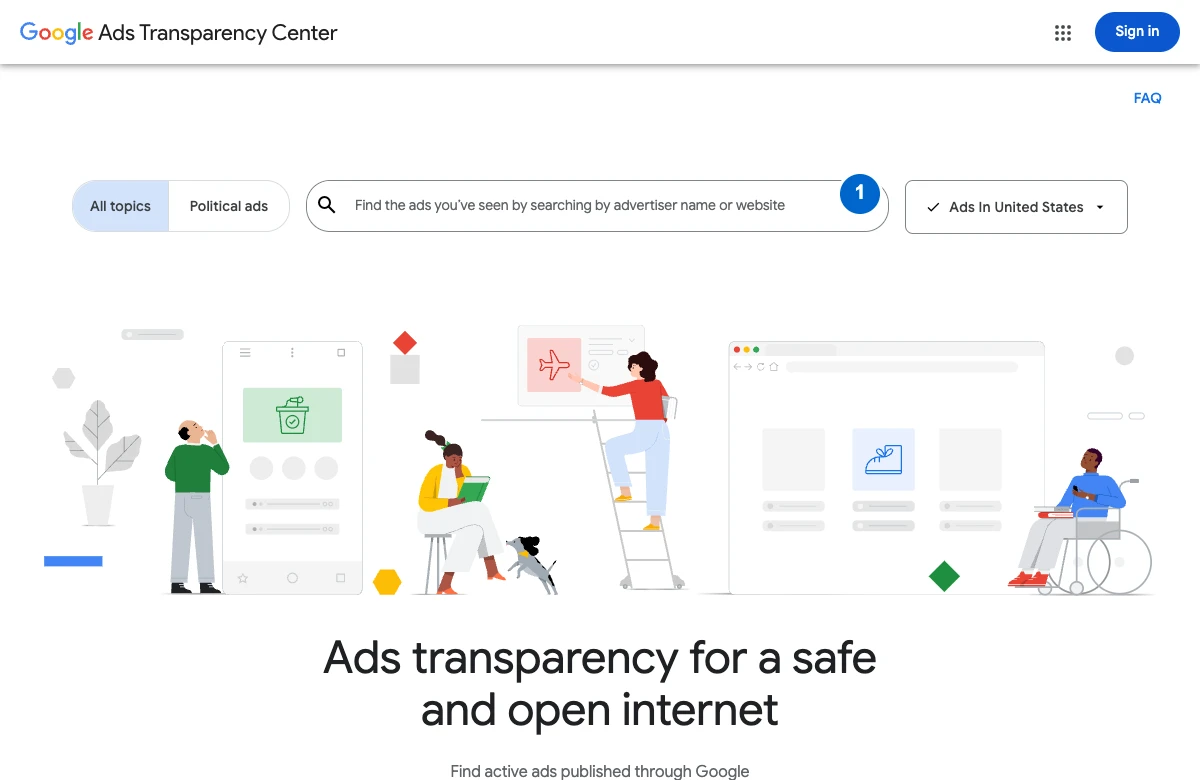
Research the message without inventing the results
12. Social proof: put the right evidence beside the right claim
Build this: A permissioned evidence library with clear scope, period and attribution.
Collect the evidence your buyer needs to evaluate the promise: actual product screens, documented work, permissioned testimonials and results with a period and denominator. Match the evidence to the claim. An award can support credibility, but it does not prove that every buyer will achieve the same outcome. Company revenue is not personal income, and a single example does not establish a typical result.
Keep the original source, permission and context with each asset. Label illustrative charts and representative imagery. Do not create fictional reviews or use AI to manufacture a customer endorsement. When the evidence is limited, narrow the claim instead of adding a stronger headline. Recheck proof when the product, offer or relevant terms change.
Verify it: Ask what each image actually establishes. Remove or relabel anything that implies more than the evidence supports.
Follow the complete implementation lesson →
13. AI setup: establish inputs, boundaries and a review owner
Build this: An operating rule for where AI can assist and how its work is verified.
The wider blueprint retains AI setup beyond the twelve-item checklist. Before connecting tools, define the job, allowed inputs, prohibited information, output format and acceptance test. Keep credentials, customer data and private strategy out of unapproved services. Use the minimum information needed, and treat retrieved content as source material rather than trusted instructions.
Start with a bounded workflow such as preparing an outline from approved notes. Review claims, run code or calculations in a safe environment, and keep a fallback when the output fails. If an AI-driven action writes to a business system, define authorization, logging, duplicate handling and recovery before enabling it. Installing a tool is not evidence that the workflow is dependable.
Verify it: Run a normal case, missing-input case and incorrect-output case. Confirm a person can detect and recover from failure.
Follow the complete implementation lesson →
14. Onboarding: deliver the first useful outcome
Build this: A documented journey from payment or commitment to customer activation.
Name the first outcome the customer bought, then work backward through the required steps. Record who owns each handoff, what information is needed and the expected timing. A welcome email sent or an account created is not automatically activation. Define the observable event that shows the customer reached value.
Test the full path with fictional data in an authorized environment. Check missing information, access problems, duplicate events and delayed payment where relevant. Keep a visible queue for stalled customers and a recovery owner. If acquisition increases faster than delivery capacity, the marketing system can damage the experience it was meant to improve.
Verify it: Trace one test customer from accepted commitment through the first-value event and verify each destination record.
Follow the complete implementation lesson →
15. Client retention: measure whether the promise continues to hold
Build this: A cohort-based retention measure and a feedback loop into the offer and delivery.
Define the eligible starting group, observation window and retained event. Subscription renewal, repeat purchase and product activity are different measures. Keep newly acquired customers out of the original cohort’s numerator, show counts beside percentages and report unknown when the window or data is incomplete. A zero denominator does not produce a meaningful retention rate.
Map reasons for friction using support evidence and permissioned customer feedback. Separate observed failures from hypotheses. Fix broken onboarding and misleading expectations before adding more promotional follow-up. Do not make cancellation difficult to improve a metric. Choose one experience improvement, track the affected cohort and explain other changes that could affect the result.
Verify it: Review acquisition quality, activation, retention and contribution together. Growth that depends on replacing disappointed customers is a signal to investigate the system.
Follow the complete implementation lesson →
Make the economics visible before you scale
Illustrative example: 1,000 qualified visits × 5% visit-to-lead rate × 20% lead-to-customer rate = 10 expected customers. At $200 net first-order revenue and $100 variable cost per customer, $600 total acquisition cost leaves $400 contribution before fixed overhead, tax, financing and cash timing. Modeled CAC is $60. These are assumptions—not our company results or a forecast for your business.
Change one input at a time and inspect what changes. Better-looking traffic or lead counts do not help if customer quality, delivery cost or refunds move against you. Include attributable sales labor, creative and tools in acquisition cost, and never deduct the same cost twice.
TRY YOUR NUMBERS / PLANNING MODEL
Can this funnel support your acquisition cost?
Use one period, one cohort and one currency. Defaults are illustrative assumptions, not your company’s results.
Formula: visits × lead rate × close rate = expected customers. Contribution after acquisition = customers × (net revenue − variable cost) − total acquisition cost. This is not net profit: fixed overhead, tax, financing and cash timing are excluded. Include attributable sales labor, creative and tools in acquisition cost; do not count a cost twice. Fractional customers are expected values, not observed people. Inputs stay in this browser and are not saved.
Audit the blueprint without grading guesses as success
The operating distinction is simple: Live means deployed and tested. Working means meeting a defined business outcome with adequate, recent evidence. Underperforming needs supported evidence of a missed target. N/A needs a reason and a review trigger. If you do not know, leave it Not assessed.
The tool below is your own browser-only assessment, not an automated audit. It begins unassessed and saves nothing after you leave. Record the evidence and review date, then download your record. Do not enter customer identities, credentials or private account details.
YOUR SELF-ASSESSMENT / NOT AN AUTOMATED AUDIT
Choose one system. Record the evidence.
All fifteen systems begin Not assessed. These are your notes; they do not describe the current state of Aaron’s companies. No answers are transmitted or saved after leaving.
0 assessed. No company performance has been inferred.
| System | Your state |
|---|---|
| Web design and sales funnels | Not assessed |
| Attribution | Not assessed |
| Lead magnet | Not assessed |
| AI VSLs and explainers | Not assessed |
| Text and email sequences | Not assessed |
| Autoblog and content operations | Not assessed |
| Cold email | Not assessed |
| AI YouTube and social publishing | Not assessed |
| AI outreach | Not assessed |
| Affiliate setup | Not assessed |
| Ads | Not assessed |
| Social proof | Not assessed |
| AI setup | Not assessed |
| Onboarding | Not assessed |
| Client retention | Not assessed |
Use a weekly review to choose the next move
- Reconcile the measures: traffic from analytics, pipeline from the CRM, outcomes from the relevant delivery or billing system, and cash from payment records.
- Check freshness and definitions: missing targets, incomplete observations, duplicate records and stale evidence should remain unknown.
- Choose one constraint: identify the handoff that prevents the next useful business result.
- Assign one action: state the owner, due date, expected evidence and proceed/revise/stop rule.
- Review economics and capacity: examine contribution, cash, activation and retention before expanding acquisition.
For example, if qualified calls occur but proposals repeatedly lose on unclear scope, fix the offer and proposal before adding traffic. If customers buy but fail to activate, inspect onboarding. The next useful task follows the evidence; it is not automatically another channel or another subscription.
Your completion check
0 / 8 checkedCheck only what you have verified. Download your record before leaving.
Start with the part that is holding you back
You do not have to build the entire blueprint this week. Pick one broken or unproven handoff, open the matching lesson, and leave with a tested output. That is how this becomes a system you can improve instead of a list you keep postponing.
Start the free implementation lessons →
Or write one bounded fourteen-day test →
Sources and scope
Adapted from my Marketing Blueprint Checklist and its operating instructions, reviewed October 27, 2026. The build order, explanations and examples in this article are an instructional adaptation. Internal workbook records and account details are not reproduced. Current platform requirements should be checked in the sources below.