Marketing Blueprint / Lesson 12 of 16
Build Affiliate Recommendations That Deserve the Reader’s Trust
Lesson 12 of 16. A disclosed recommendation system with issued links, reader-fit criteria and link QA. Six implementation steps, a worked example, an editable brief and a completion checklist.
By Aaron Peden · Published · Updated October 27, 2026
LESSON 12 / TRUST
What you will build: A disclosed recommendation system with issued links, reader-fit criteria and link QA.
An affiliate link should appear because the tool helps the reader complete a task—not because it offers the largest commission. Start with the workflow, identify the capability needed and explain when the tool is unnecessary. Keep the lesson usable without purchasing software. A clear recommendation includes a limitation and a practical alternative.
This lesson builds the publisher side of affiliate marketing. If your business wants to recruit affiliates, use a separate program design covering agreements, approved claims, tracking, fraud review and payouts. Do not confuse a tool recommendation on your blog with a fully operating affiliate program for your own company.
- 01Map tools to reader jobs
- 02Verify the program and issued destination
- 03Write an honest fit-based recommendation
- 04Place disclosure near the recommendation
- 05Test redirects, mobile behavior and tracking preservation
- 06Maintain the inventory and measure useful referrals
Before you start
Bring the working brief from the previous lesson. Keep your current offer, customer definition, authoritative sources and delivery constraints available. If a prerequisite is incomplete, return to that lesson before connecting a live workflow.
Use a private draft or safe testing environment for implementation. The examples below use fictional data and do not describe customer results at Rocktomic, YourPeptideBrand or WellStaq. Nothing in this lesson launches ads, sends outreach or changes your accounts.
BUILD STEP 01
Map tools to reader jobs
List the concrete jobs in your content: build a page, send a permission-based sequence, inspect technical SEO or research a public website. Define the minimum capability and the point at which a paid product becomes useful. Separate essential infrastructure from optional convenience. Avoid listing five interchangeable subscriptions as though a beginner needs all of them. If a document or existing website can accomplish the job, say so before introducing another recurring expense.
Verify before moving on: Every recommendation has a specific job, suitable reader and reason to skip it.
BUILD STEP 02
Verify the program and issued destination
Use the exact link issued by the program or approved inventory. Preserve query strings and referral fragments; do not invent a campaign code. Match specialized links to their intended destination and avoid replacing a general tutorial link with an unrelated event or upsell. Check program restrictions, eligibility and current terms before making promotional claims. A working destination does not prove your attribution or commission is guaranteed. Record the source and verification date without publishing private account details.
Verify before moving on: The stored link matches an issued link and its destination fits the article.
BUILD STEP 03
Write an honest fit-based recommendation
Explain what the product may help the reader do, prerequisites, meaningful limits and an alternative. Distinguish personal experience, vendor documentation and untested expectations. Do not claim you personally use a tool without evidence or attribute your company results to it by association. Avoid unsupported pricing, savings or trial statements that change frequently. If you have not tested a feature, say which decision the reader should verify before paying.
Verify before moving on: A reader can make a reasoned decision even if they choose not to use your link.
BUILD STEP 04
Place disclosure near the recommendation
Explain clearly that you may earn a commission from eligible purchases through the links. Put the disclosure where the relationship affects the reader’s decision, not only in a footer. Use rel=sponsored for paid affiliate links; add noopener when opening a new tab. Keep links recognizable, descriptive and accessible. If the post is repurposed into video or social content, carry the disclosure into that format rather than assuming the website policy covers every placement.
Verify before moving on: The relationship is obvious before the reader clicks and paid links are marked appropriately.
BUILD STEP 05
Test redirects, mobile behavior and tracking preservation
Open the public article on desktop and mobile. Confirm the link destination, HTTPS, referral parameter or fragment and any redirect behavior you can observe. Some providers use anti-bot controls, so distinguish an automated check failure from a broken visitor journey. Do not make a purchase or use a self-referral to test attribution. Keep the exact issued link in the page source even if a provider later rewrites it. Test downloadable assets and video descriptions too.
Verify before moving on: Public source links retain the issued attribution and take the reader to the intended product or offer.
BUILD STEP 06
Maintain the inventory and measure useful referrals
Assign an owner to check broken destinations, changed products, outdated claims and relevant alternatives. Track clicks and eligible reported outcomes without promising commission or treating pending payouts as cash. Keep private payout and account information out of public content. Remove a recommendation that no longer fits, even if the link still works. Review whether the surrounding lesson remains useful independently of the sale; reader trust is an operating constraint, not an afterthought.
Verify before moving on: Every active recommendation has a current fit review, valid link and transparent relationship statement.
Preserve attribution while keeping links readable
Store the full issued destination separately from the display label. When rendering HTML, escape the URL correctly without deleting an ampersand parameter or a referral fragment. Prefer clear labels such as Explore Sender instead of click here. A provider redirect may change the visible final URL, so keep the original issued URL in the inventory and public source. Mark paid relationships with rel=sponsored and disclose the relationship near the recommendation. Do not add your own fabricated discount, promise an unverified trial or use a self-purchase as an attribution test. Keep specialized workshop, certification and registration links in content that actually discusses those destinations.
WORKED EXAMPLE / FICTIONAL INPUTS
See how the decisions fit together
Fictional example: a beginner wants to send a five-message educational sequence. The lesson first shows how to map enrollment and stop rules. It then presents one email platform as an option, a CRM suite for readers who also need pipeline management and a manual document-based planning alternative. The article discloses the relationship before the links. A higher-commission video tool is omitted because it does not solve this task. If a referral dashboard reports an eligible purchase, the publisher still waits for the program’s approval and payout process before treating it as received revenue.
Replace these assumptions with your own supported inputs. Keep unknowns visible and avoid treating this example as a benchmark, a forecast or a result you should expect.
A starting specification you can copy
Product / reader job / useful when / skip when / alternative
Issued URL + offer type + inventory source + checked date
Relationship: affiliate; commission may be earned on eligible purchases
Evidence: personal test | vendor documentation | not yet tested
Markup: descriptive anchor + rel=sponsored + readable disclosure
Maintenance: destination / attribution / claims / product fit / owner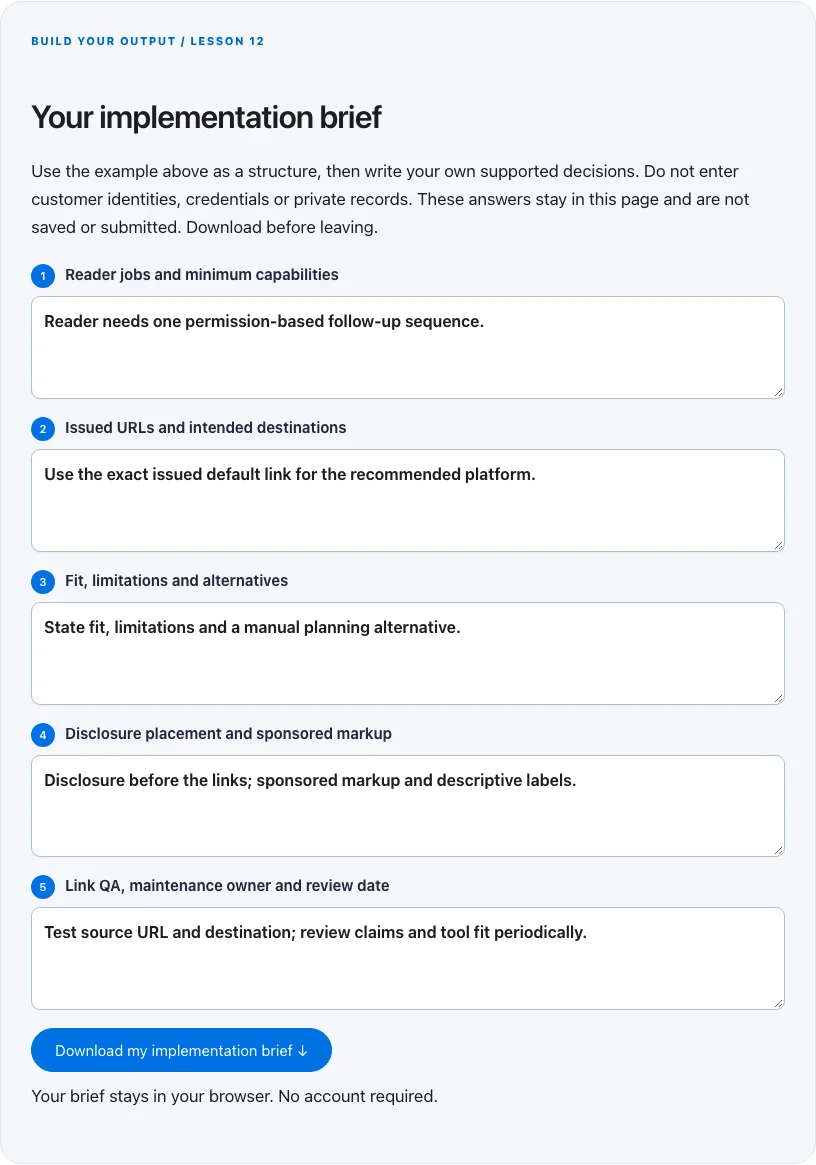
Troubleshoot before you add more tools
| What you notice | What to check next |
|---|---|
| The link works but points to the wrong offer | Match the issued specialized destination to the article’s actual task. |
| The post reads like a list of sales pitches | Teach the workflow first and remove tools without a distinct reader job. |
| The referral code disappears | Check the original HTML, redirect path and platform handling of query strings or fragments. |
BUILD YOUR OUTPUT / LESSON 12
Your implementation brief
Use the example above as a structure, then write your own supported decisions. Do not enter customer identities, credentials or private records. These answers stay in this page and are not saved or submitted. Download before leaving.
Your brief stays in your browser. No account required.
OPTIONAL TOOLS / CHOOSE FOR THE JOB
Tools that fit this lesson
Affiliate disclosure: I may earn a commission if you purchase through these affiliate links. You do not need to buy a tool to complete this lesson. These are fit-based options, not a claim that I personally use every product or that a product caused our companies’ results. Check current features, pricing and terms before buying.
Replug — explore the tool ↗
An optional link-management tool for organized destinations and campaigns. Preserve issued affiliate parameters and test redirects. A maintained link spreadsheet and direct URLs can be sufficient.
Free starting point: plan the workflow in a document or spreadsheet and test it using tools you already have. Buy a capability only when a verified constraint justifies it. Read the full affiliate disclosure.
Done means verified.
0 / 6 checkedCheck a line only when you have the evidence. A downloaded plan is a starting point; it does not prove that the live workflow works.
Verify all six checks to mark complete.
Review the evidence, then continue
Keep the output you created, the test date, the source of truth and the result of each completion check. Mark a system Live after the path is deployed and tested. Mark it Working only when adequate recent evidence meets a defined outcome target. If the lesson does not fit your business or stage, write the reason and a review trigger instead of pretending it is complete.
Choose one next action, assign an owner and set a review date. More tools, more traffic or more automation are not automatically the next step. The next lesson builds on this artifact, so resolve missing inputs or failed checks before expanding the system.
Go deeper when you need it
Primary references and further reading
Provider interfaces, limits and policies can change. Check the current official instructions for your account before implementing. This article teaches an operating method; it does not independently certify compliance or business performance.