Free implementation guide / 07
Understand What You Can Afford to Pay for a Customer
Separate revenue from profit, set a conservative acquisition target, and test the numbers before scaling.
A customer-acquisition ceiling you can compare with actual CAC.
Revenue, delivery costs, variable costs, acquisition spend and new customers from the same period or cohort.
Jump to the working checklist ↓
Aaron Peden
Founder & CMO · Practical business education
The outcome
Calculate a first-order acquisition target and compare it with actual acquisition cost from a consistent customer cohort.
This playbook is general educational guidance. The worked example is hypothetical, not a claim about Aaron’s personal results.
01Define the unit and the period
Start with one new paying customer and their first completed order. Use a consistent currency and a defined period. A lead is not a customer; a signed contract is not always collected cash. State how you treat cancellations and refunds.
For businesses with long buying cycles, group spend and customers by an acquisition cohort that has had time to convert. Dividing this week’s ad spend by customers from last quarter produces a misleading result. If attribution is uncertain, label it uncertain.
02Separate three different amounts
Revenue is the sales amount, adjusted consistently for discounts and expected refunds. Gross profit is revenue minus direct delivery costs such as product cost or delivery labor. Contribution before acquisition subtracts other variable costs such as transaction fees and variable support.
Avoid double-counting. If shipping or fees are already included in direct costs, do not subtract them again. Define your categories and use them consistently. Accounting classifications vary; this worksheet is an operational planning tool, not a replacement for your accounts.
SEE THE ACTUAL EXAMPLE
Read the inputs and the result together
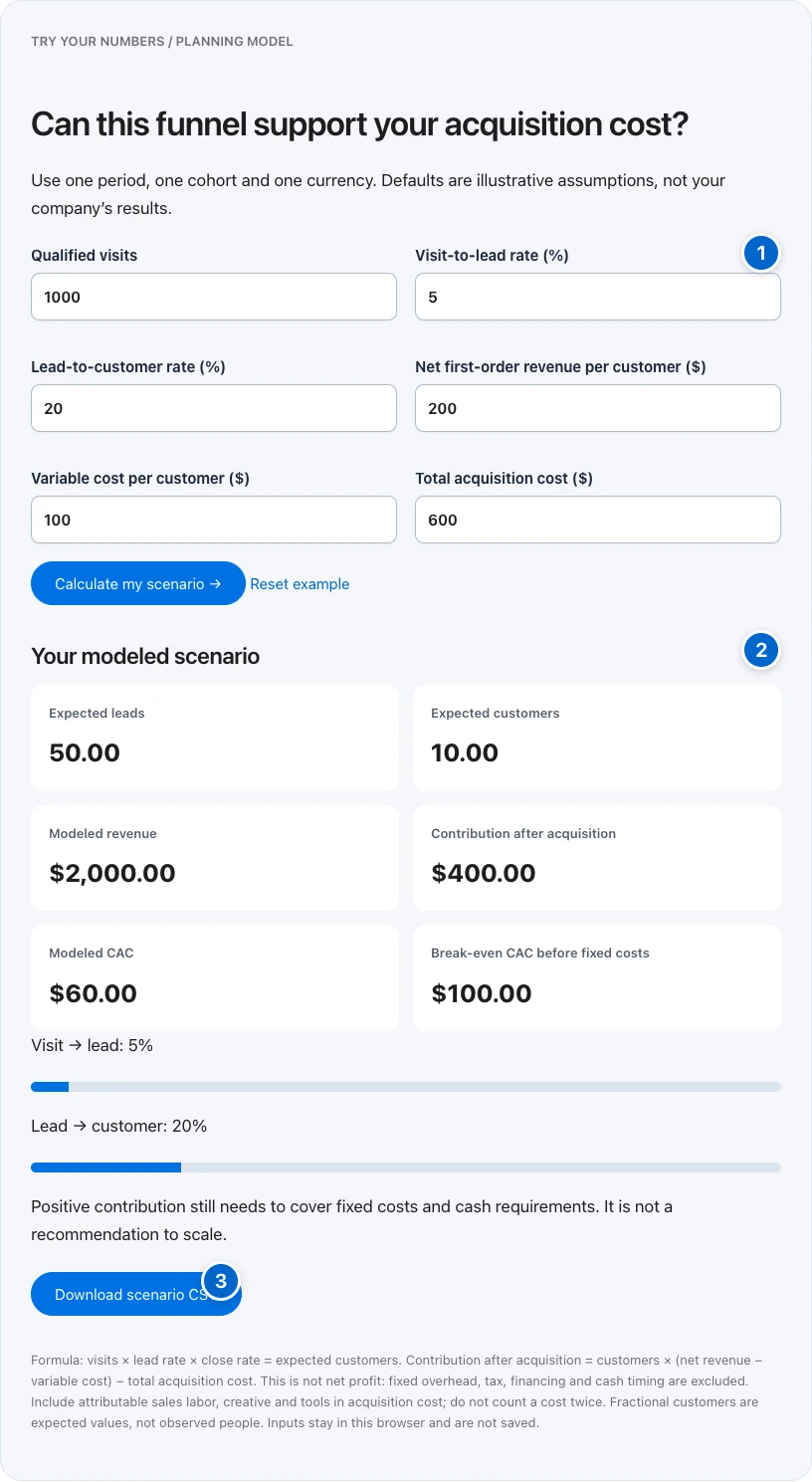
Your action: Replace all assumptions with your own numbers. Check which costs are included before judging affordability.
Open the pictured tool or exercise →
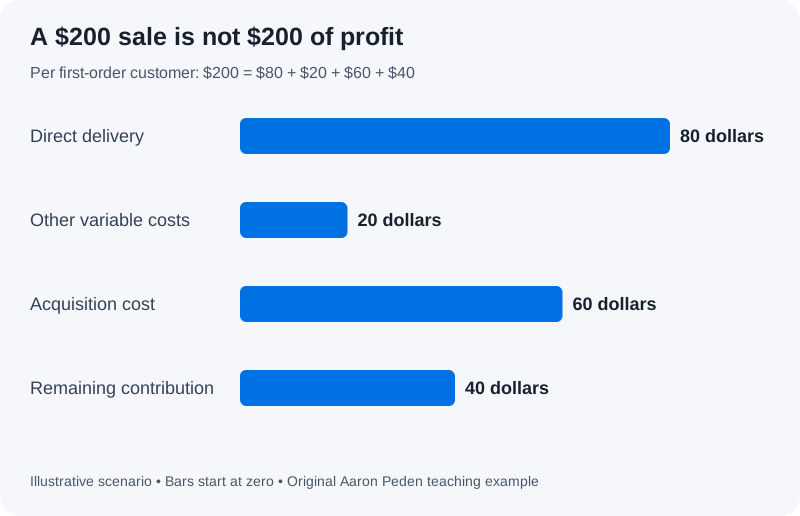
| Use of $200 collected | Dollars |
|---|---|
| Direct delivery | 80 |
| Other variable costs | 20 |
| Acquisition cost | 60 |
| Remaining contribution | 40 |
03Reserve something for the rest of the business
Contribution before acquisition is an upper boundary, not automatically a sensible spending target. The business still needs to cover fixed overhead, financing, tax and uncertainty. Choose an amount to retain per customer after acquisition.
Target CAC = revenue − direct delivery costs − other variable costs − contribution to retain. If the result is negative, the requested reserve is not achievable at those economics even with zero acquisition spend. Improve the offer or cost structure before treating ads as the solution.
04Measure actual acquisition cost
Actual CAC = total acquisition spend ÷ new paying customers. Include relevant advertising, sales labor, creative and acquisition tools. You may report both cash-only and fully allocated CAC, but label them and never compare one against the other without adjustment.
With zero customers, CAC is undefined. It is not zero and it is not proof that the next dollar will convert. Record the spend, investigate the test and respect the loss limit. A small sample can swing dramatically with one additional customer.
05Check cash timing before scaling
A business can appear profitable and still run out of cash if acquisition and delivery costs arrive before customers pay. Map when money leaves and when payments clear. Model refunds, failed payments and slower conversion.
Use first-order economics until repeat purchase behavior is supported by mature cohorts. Do not multiply optimistic retention assumptions into an impressive lifetime value. Increase spend in measured steps while watching whether CAC and delivery quality change.
Worked example — hypothetical
Hypothetical first order: $200 revenue − $80 direct delivery cost = $120 gross profit. Subtract $20 other variable costs to get $100 contribution before acquisition. Retaining $40 leaves a target CAC of $60. If a matched cohort costs $600 to acquire and produces ten new paying customers, actual CAC is $60 and contribution after acquisition is $40 per customer. That $40 is not net profit: fixed overhead and tax still remain.
Download the printable worksheet ↓
The worksheet opens in a browser and can be printed or saved as PDF. No email address is required.
Common mistakes
- Comparing revenue directly with advertising spend and calling the difference profit.
- Counting repeat customers as newly acquired customers.
- Using projected lifetime revenue instead of observed contribution.
- Treating an undefined CAC as a free customer channel.
Your next action
Fill in conservative first-order numbers. Use the calculator, then check whether the cash timing and fixed overhead make the target workable.
Open the customer acquisition calculator →
Illustrative example / Not company results
Give every acquisition dollar a job.
Use the same period for spend and customers. Then compare CAC with contribution per customer.
Try your own numbers ↗- 01Net revenue
Account for refunds once.
- 02Subtract delivery costs
Separate variable costs from overhead.
- 03Reserve contribution
Keep room for fixed costs and cash needs.
- 04Set a CAC ceiling
Compare against fully loaded acquisition cost.
TRY YOUR NUMBERS / PLANNING MODEL
Can this funnel support your acquisition cost?
Use one period, one cohort and one currency. Defaults are illustrative assumptions, not your company’s results.
Formula: visits × lead rate × close rate = expected customers. Contribution after acquisition = customers × (net revenue − variable cost) − total acquisition cost. This is not net profit: fixed overhead, tax, financing and cash timing are excluded. Include attributable sales labor, creative and tools in acquisition cost; do not count a cost twice. Fractional customers are expected values, not observed people. Inputs stay in this browser and are not saved.
Make the idea concrete.
At $200 revenue, $80 direct cost and $20 other variable costs, contribution before acquisition is $100. Retaining $40 leaves a $60 planning CAC ceiling. Spending $600 to acquire 10 customers produces $60 actual CAC. Fixed costs and cash timing still need review.
Done means verified.
Check each item as you verify it. Progress stays in this page; download your checklist before leaving.