Marketing Blueprint / Lesson 16 of 16
Measure Customer Retention and Build a Feedback Loop That Improves the Business
Lesson 16 of 16. A cohort-based retention report and practical action plan tied to ongoing customer value. Six implementation steps, a worked example, an editable brief and a completion checklist.
By Aaron Peden · Published · Updated October 27, 2026
LESSON 16 / DELIVERY
What you will build: A cohort-based retention report and practical action plan tied to ongoing customer value.
Retention is evidence that the original promise continues to matter. It should not be manufactured through hidden cancellation steps, misleading renewal language or repeated sales pressure. Define what retained means for your business, observe eligible cohorts and use customer feedback to improve the product, offer and delivery.
A subscription, a repeat-purchase product and a one-time service need different measures. Do not force a monthly subscription metric onto a business that does not sell subscriptions. Begin with the value event and an appropriate observation window, then separate customer retention, revenue retention and cash collection.
- 01Define a meaningful retention event
- 02Build cohorts before calculating averages
- 03Separate customer, revenue and contribution measures
- 04Collect feedback at moments that reveal problems
- 05Design an intervention with a clear hypothesis
- 06Feed learning into acquisition and the offer
Before you start
Bring the working brief from the previous lesson. Keep your current offer, customer definition, authoritative sources and delivery constraints available. If a prerequisite is incomplete, return to that lesson before connecting a live workflow.
Use a private draft or safe testing environment for implementation. The examples below use fictional data and do not describe customer results at Rocktomic, YourPeptideBrand or WellStaq. Nothing in this lesson launches ads, sends outreach or changes your accounts.
BUILD STEP 01
Define a meaningful retention event
For subscriptions, define whether retained means active and paid at a specific date and how trials, pauses and failed payments are treated. For repeat purchase, define the eligible purchase window and relevant product cycle. For a one-time service, repeat purchase or referral may be useful but is not the same as subscription retention. State exclusions, timezone and cohort entry rule. Preserve the original definition when comparing periods or explain a change explicitly.
Verify before moving on: The report states exactly who is eligible, what counts as retained and when it is observed.
BUILD STEP 02
Build cohorts before calculating averages
Group customers by a meaningful starting event such as first paid month or first completed purchase. Compare equivalent ages, not a new cohort’s first week with an old cohort’s sixth month. Keep immature cohorts separate. Use one customer identity rule to avoid double counting across products or accounts. Retain the cohort’s original eligible count and a documented policy for exclusions. Do not silently remove unhappy customers from the denominator.
Verify before moving on: Every reported rate has a stable eligible denominator and a comparable observation window.
BUILD STEP 03
Separate customer, revenue and contribution measures
Customer retention measures how many eligible customers remain. Revenue retention measures recurring revenue from the starting cohort under a defined method; expansion, contraction and churn affect it differently. Contribution includes relevant costs and is not the same as revenue. For subscriptions, distinguish gross and net revenue retention and exclude new customers from the starting cohort’s revenue-retention calculation. Reconcile billing states and refunds before using the result to justify higher acquisition spend.
Verify before moving on: The dashboard labels each measure and does not substitute revenue growth for retained customer value.
BUILD STEP 04
Collect feedback at moments that reveal problems
Review onboarding delays, support themes, cancellation reasons, refund requests and actual usage where appropriate. Ask short specific questions about the task the customer wanted to accomplish and where progress stopped. Make cancellation and opt-out paths clear. Do not pressure people to change reviews or withhold support until they provide a testimonial. Store feedback securely, minimize personal information and share useful themes with the people who can fix the underlying cause.
Verify before moving on: Feedback categories connect to concrete delivery or product decisions and have an accountable owner.
BUILD STEP 05
Design an intervention with a clear hypothesis
Choose one supported cause, such as confusing setup, slow first response or a missing recurring value milestone. Define the affected cohort, proposed change, cost, owner and observation period. A helpful education sequence may suit an understanding gap; it will not fix a defective product. If testing a win-back message, respect channel permission, suppression and the customer’s reason for leaving. Keep the offer and renewal terms transparent and avoid claiming a retention effect from a small uncontrolled sample.
Verify before moving on: The action addresses an observed cause and states the outcome that would justify keeping it.
BUILD STEP 06
Feed learning into acquisition and the offer
Review which segments activate, remain and produce acceptable contribution. Use those patterns to refine the initial promise and acquisition targeting without overgeneralizing from small cohorts. Keep retention assumptions separate from observed results when calculating allowable CAC. Compare new cohorts after the intervention at equivalent ages and note seasonality or other changes. If the business cannot retain or deliver profitably, fix that constraint before assuming more traffic will solve growth.
Verify before moving on: The next acquisition or product decision cites mature customer evidence and preserves its limitations.
Build the cohort table before the headline chart
Create rows for cohort start and columns for equivalent observation ages. Store eligible starting customers, retained customers and the defined value event. Use blank or Not yet eligible for immature cells rather than zero. For recurring revenue, keep starting revenue, churn, contraction and expansion separate and exclude newly acquired customers from the original cohort’s retention calculation. Add a source, owner and updated date. Reconcile unusual movements against the billing or order system before declaring a trend. A chart without these definitions can look precise while comparing incompatible periods. Use the table to identify the first stage where later cohorts differ, then investigate the actual customer experience.
WORKED EXAMPLE / FICTIONAL INPUTS
See how the decisions fit together
Fictional cohort: fifty eligible subscription customers begin a month and thirty-five remain paid and active at the observation date. Customer retention is 35 ÷ 50 = 70%. If starting recurring revenue was $5,000, churn removed $1,500, contraction removed $200 and expansion added $400, gross revenue retention is ($5,000 − $1,500 − $200) ÷ $5,000 = 66%; net revenue retention is ($5,000 − $1,500 − $200 + $400) ÷ $5,000 = 74%. New-customer revenue is excluded. These are illustrative calculations, not a target or company performance claim.
Replace these assumptions with your own supported inputs. Keep unknowns visible and avoid treating this example as a benchmark, a forecast or a result you should expect.
A starting specification you can copy
Cohort entry: [first paid event and period]
Eligible starting customers: [count]
Retained at comparable age: [count and definition]
Customer retention = retained / eligible starting
GRR = (starting recurring − churn − contraction) / starting recurring
NRR = (starting recurring − churn − contraction + expansion) / starting recurring
Review: causes / intervention / cost / owner / next observation date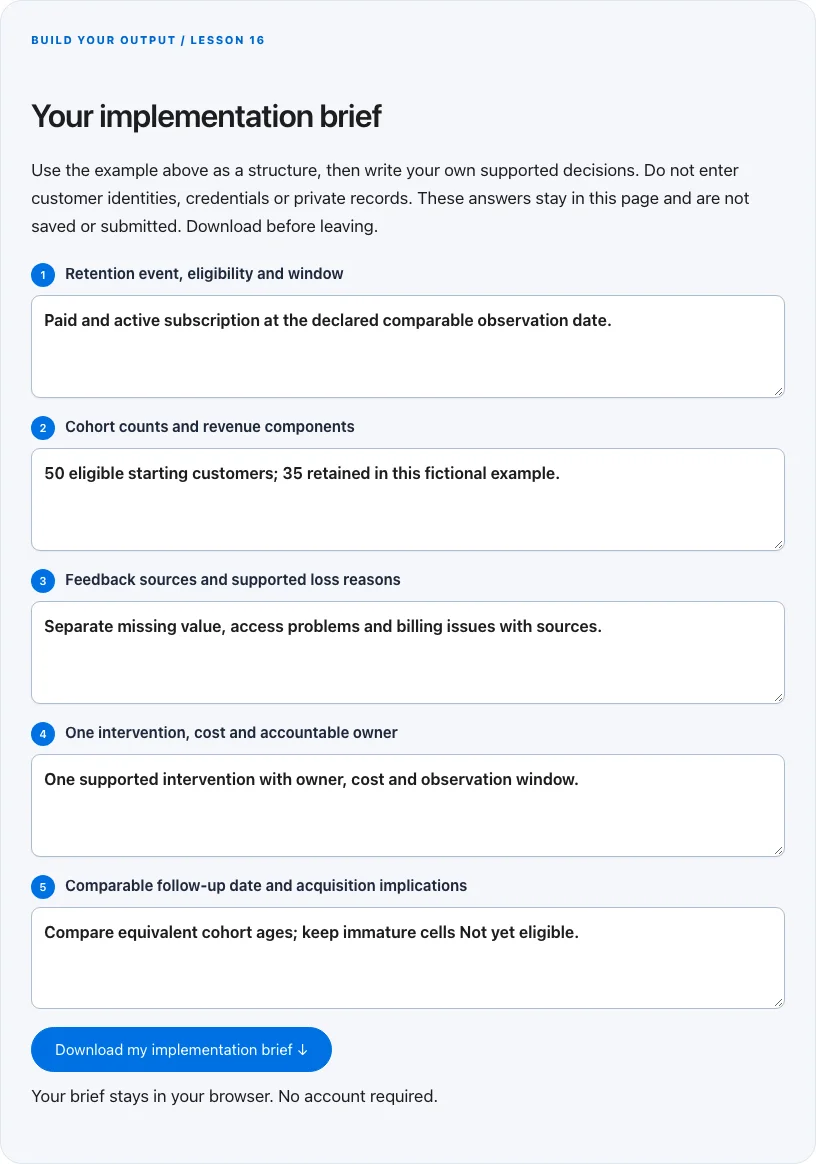
Troubleshoot before you add more tools
| What you notice | What to check next |
|---|---|
| Revenue grows while customers leave | Separate new revenue from cohort retention and inspect expansion concentration. |
| The retention rate changes after editing the report | Check cohort eligibility, maturity and exclusions before interpreting the difference. |
| More reminders do not improve retention | Investigate whether the product delivers ongoing value; messaging cannot repair every delivery problem. |
BUILD YOUR OUTPUT / LESSON 16
Your implementation brief
Use the example above as a structure, then write your own supported decisions. Do not enter customer identities, credentials or private records. These answers stay in this page and are not saved or submitted. Download before leaving.
Your brief stays in your browser. No account required.
OPTIONAL TOOLS / CHOOSE FOR THE JOB
Tools that fit this lesson
Affiliate disclosure: I may earn a commission if you purchase through these affiliate links. You do not need to buy a tool to complete this lesson. These are fit-based options, not a claim that I personally use every product or that a product caused our companies’ results. Check current features, pricing and terms before buying.
GoHighLevel — explore the tool ↗
Consider a CRM-centered workflow when you need pipeline ownership and connected follow-up. Map the states first and test the relevant integrations. A simpler tool may be enough for a single page or sequence.
Sender — explore the tool ↗
An email-delivery and automation option for permission-aware sequences. Verify authentication, unsubscribe, segmentation and the actual plan limits. Draft and test the logic before enrolling a real audience.
Calilio — explore the tool ↗
A business-phone option when the workflow needs accountable calling or routing. Confirm geography, number availability, recording/privacy requirements and usage charges. A phone system is unnecessary for a purely self-serve digital task.
Free starting point: plan the workflow in a document or spreadsheet and test it using tools you already have. Buy a capability only when a verified constraint justifies it. Read the full affiliate disclosure.
Done means verified.
0 / 6 checkedCheck a line only when you have the evidence. A downloaded plan is a starting point; it does not prove that the live workflow works.
Verify all six checks to mark complete.
Review the evidence, then continue
Keep the output you created, the test date, the source of truth and the result of each completion check. Mark a system Live after the path is deployed and tested. Mark it Working only when adequate recent evidence meets a defined outcome target. If the lesson does not fit your business or stage, write the reason and a review trigger instead of pretending it is complete.
Choose one next action, assign an owner and set a review date. More tools, more traffic or more automation are not automatically the next step. The next lesson builds on this artifact, so resolve missing inputs or failed checks before expanding the system.
Go deeper when you need it
- Measure customer retention with a clean cohort →
- Design a lead handoff that survives retries →
- Customer acquisition cost →
Primary references and further reading
Provider interfaces, limits and policies can change. Check the current official instructions for your account before implementing. This article teaches an operating method; it does not independently certify compliance or business performance.