Technical tutorial / Conversion & Landing Pages
Audit a Landing Page from Promise to Accepted Enquiry
Use a message test, a form-state test matrix and a measurement check to find specific conversion problems.
By Aaron Peden · Published · Updated October 27, 2026
Build this: An evidence-backed fix list covering the offer, mobile experience and actual enquiry path.
Before you start: A landing page you control and a safe way to test its enquiry destination without contacting real customers.
Conversion work starts with knowing what a person is trying to do and whether the page lets them do it. A prettier hero cannot repair an enquiry that never arrives. This audit checks comprehension, credibility and the full action path before proposing an experiment.
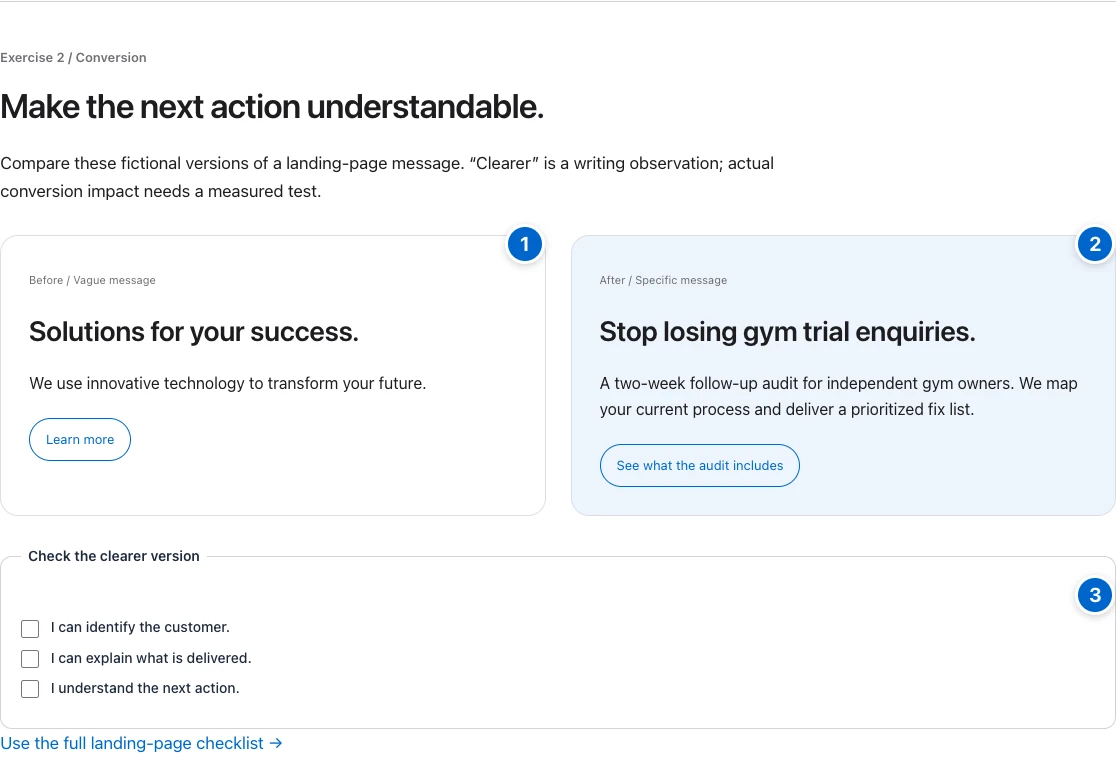
Keep observations separate from measured impact. You can establish that a label is ambiguous or that a form rejects valid input. You cannot establish a conversion lift by comparing two screenshots. The before-and-after practice example below demonstrates specificity, not an A/B test result.
1. Write the arrival context
Record the traffic source, query or message that brings the visitor to the page. Then write what they expect to find. If an ad promises a priced audit but the destination offers an unspecified consultation, the mismatch is a concrete issue. Save the ad or referring message with the page version so the review has context.
Choose one primary outcome appropriate to the offer. A service enquiry, checkout and newsletter signup need different information and measurement. Avoid making every element equally prominent. Secondary links can help evaluation, but they should not obscure the main decision.
2. Run a five-question comprehension check
Ask someone unfamiliar with the page who it is for, what is delivered, what it costs or how price is determined, what happens next and why they should trust it. Do not explain the answers while testing. Record the exact confusion rather than translating it into a vague score.
Use the practice comparison to see the difference between generic benefit language and a specific customer, scope and action. Then apply that lens to your own headline and supporting copy. Specificity should be accurate: adding a precise delivery time you cannot honor makes the page clearer and less trustworthy at the same time.
See the actual example
3. Inspect evidence and boundaries
Every testimonial, logo, result and screenshot should have a defensible source and permission where needed. State what a result measures and the period it covers. Company revenue is not founder income; an illustrative dashboard is not observed campaign performance. Put relevant proof near the claim it supports.
List exclusions and customer responsibilities before the primary commitment. For a scoped service, tell the reader whether implementation is included. For a product, show the applicable terms and limitations. Hidden boundaries may increase initial clicks while creating poor-fit enquiries and later refunds.
4. Test success, rejection and repetition
Write a test matrix before clicking: valid submission, missing required input, invalid input, backend rejection, slow response and repeated click. Use fictional data in a controlled environment. Observe the visible status and the destination record for each case. A thank-you message alone does not prove delivery.
The tracking screenshot shows the safe practice form after acceptance. Repeat it after rejection: the local conversion count should remain zero. Your production form needs equivalent tests against its real backend and analytics. Check recovery instructions so a user knows what to do after a failure without submitting five duplicates.
Worked example — illustrative or dated as stated
Illustrative finding: five people understand the customer and service, but three cannot tell whether the quoted audit includes implementation. Rewrite the scope and the next-action explanation. That is a defensible clarity fix. It is not evidence that the revision will increase sales by a stated percentage.
5. Check the page on mobile and keyboard
Use a narrow viewport and a real device when available. Read the page without zooming, reach the primary action with keyboard navigation and verify visible focus. Labels must remain connected to their inputs. Error messages should identify the field and the correction, not rely on red color alone.
Inspect image dimensions and loading behavior so late assets do not move the action while someone is tapping it. Check sticky banners and cookie controls for overlap. A desktop screenshot cannot validate these states; save evidence at the widths and interaction states you actually tested.
6. Prioritize fixes and define the next test
Fix broken delivery, misleading claims and inaccessible controls before running a persuasion experiment. For a genuine test, define one change, one primary outcome, traffic allocation and a review method appropriate to the volume. Monitor lead quality and downstream sales, not only the action count.
Do not stop a test the moment a preferred version looks ahead. If there is not enough evidence, report that honestly. Keep the baseline and the changed version, and explain what remains uncertain. The audit is complete when each finding has a reproducible observation, an owner and a verification check.
YOUR IMPLEMENTATION WORKSHEET
Build your working document.
Enter planning notes without customer identities or secret values. Your answers stay in this browser and are not saved. Download the completed brief before leaving.
No information is submitted to a server.
Completion checklist
0 / 8 checkedCheck only what you have verified. Download before leaving; this page does not save your progress.
Sources and scope
Primary-source guidance checked October 27, 2026. Interfaces and policies can change; consult the linked current source. Practice screenshots and modeled examples are labeled and are not client campaign results.