Marketing Blueprint / Lesson 01 of 16
Create an Offer People Understand, Want and Can Profitably Buy
Lesson 01 of 16. A priced, deliverable offer with a documented customer, margin model and demand test. Six implementation steps, a worked example, an editable brief and a completion checklist.
By Aaron Peden · Published · Updated October 27, 2026
LESSON 01 / FOUNDATION
What you will build: A priced, deliverable offer with a documented customer, margin model and demand test.
An attractive website cannot fix an offer that nobody understands. Before choosing software, decide whose expensive problem you solve, what they receive, how the transaction works and whether you can deliver it. If you already have customers, optimize the existing offer before inventing another one. The output of this lesson is a one-page offer brief and a small test—not a new logo or a claim that demand has been proven.
Separate three questions: can the buyer explain the offer, will the buyer take a meaningful next step, and can you fulfill that promise at an acceptable contribution? A positive answer to one does not settle the others. Keep the evidence for each question separately.
- 01Choose one customer and one purchase situation
- 02Define the deliverable, boundaries and next action
- 03Price from delivery economics before acquisition
- 04Make the mechanism and proof specific
- 05Run a small demand test with a stop rule
- 06Review objections and change one constraint
Before you start
Start here. Write down the business you want to improve, your current offer and the customer you can realistically serve. You do not need a paid tool to complete this lesson.
Use a private draft or safe testing environment for implementation. The examples below use fictional data and do not describe customer results at Rocktomic, YourPeptideBrand or WellStaq. Nothing in this lesson launches ads, sends outreach or changes your accounts.
BUILD STEP 01
Choose one customer and one purchase situation
Describe the buyer by the problem and buying context, not simply an age range. Write what has happened immediately before they start looking for help, what they currently use, who approves the purchase and what would make them defer. Interview existing customers about actual decisions rather than asking whether a hypothetical product sounds good. Preserve their wording without publishing identities. Exclude customers you cannot serve reliably; a narrow initial audience makes the page, sales conversation and delivery process easier to test.
Verify before moving on: A stranger can tell you who the offer serves, the trigger for buying and one clear exclusion.
BUILD STEP 02
Define the deliverable, boundaries and next action
Complete: We help [buyer] accomplish [specific task] through [deliverable]. Specify what arrives, in what format, within which delivery window and with which customer inputs. List exclusions and dependencies beside the promise. If results depend on advertising budget, implementation or third-party approval, say so. Choose a next action that matches the commitment: a scoped discovery call for complex services or a transparent checkout for a standardized purchase. A guarantee must match a policy you can actually honor.
Verify before moving on: The headline, deliverable list and next-action label describe the same transaction.
BUILD STEP 03
Price from delivery economics before acquisition
Start with expected collected revenue net of discounts and refunds. Subtract product or delivery labor, payment fees, variable support and acquisition cost. Keep fixed overhead and taxes visible separately; contribution is not net profit. Count founder delivery time at an explicit cost so a low price does not conceal unpaid labor. For subscriptions, model first-period economics before assuming renewals. Write down which inputs are estimates and which come from reconciled payment or delivery records.
Verify before moving on: Your contribution model uses one currency and identifies every assumption and excluded cost.
BUILD STEP 04
Make the mechanism and proof specific
Explain the sequence by which the deliverable helps the buyer. Replace best-in-class language with observable scope: an audit contains prioritized issues, screenshots and a review call. Attach evidence to the exact claim it supports. A founder award is background credibility, not proof that every customer will achieve the same result. Where you have no results yet, show a genuine sample deliverable, a transparent demonstration or a limited pilot with its limits stated.
Verify before moving on: Every important claim has evidence or is explicitly framed as an unproven hypothesis.
BUILD STEP 05
Run a small demand test with a stop rule
Use a focused landing page and a legitimate source of relevant prospects. Define your maximum test spend or time, the minimum useful observation window and the action that counts as demand. A compliment or a page view is weaker evidence than a qualified conversation or a purchase. Record every stage: relevant visitors, accepted enquiries, qualified opportunities and customers. With low volume, use the conversations to identify objections rather than declaring a statistically significant winner.
Verify before moving on: The test brief states its audience, channel, budget or time cap, outcome and review date before launch.
BUILD STEP 06
Review objections and change one constraint
Read lost-sale reasons alongside unit economics. No relevant visitors suggests distribution trouble; many relevant visitors but no enquiries suggests an unclear promise or weak fit; qualified conversations without purchases may expose price, trust or sales problems. Change the most supported explanation first. Preserve the previous version, dates and cohort so you can compare honestly. Mark the offer Live after the path works; call it Working only when a defined recent outcome target has adequate evidence.
Verify before moving on: The next revision names one hypothesis, one change and the evidence that will decide whether to keep it.
Use a contribution sensitivity table
Build three columns for your base estimate, a delivery-cost increase and a lower conversion outcome. Hold price constant before changing the offer so you can see which assumption drives the result. If a $250 service has $130 non-acquisition variable costs, it leaves $120 before acquisition. Retaining $40 contribution gives an $80 target acquisition allowance. If delivery cost rises by $50, the allowance falls to $30. Neither figure includes fixed overhead or tax. Enter the model in a spreadsheet with assumptions visibly separated from actuals. Keep founder time and refunds in the model once, not twice. A low introductory price is a deliberate experiment with a cap, not permission to ignore unit economics.
WORKED EXAMPLE / FICTIONAL INPUTS
See how the decisions fit together
Fictional example: a bookkeeping consultant offers a $250 cleanup review for small ecommerce stores. The deliverable is a reconciled issue list and a 30-minute review, not a promise to recover a specific amount of tax. Assume $20 in expected refunds, $100 in delivery labor, $10 in fees and $50 in acquisition. Contribution is $250 − $20 − $100 − $10 − $50 = $70 before overhead and tax. If actual delivery takes twice as long, the economics change even if conversion improves. A useful pilot records paid purchases, delivery hours and objections from eligible stores. Ten people saying “interesting” does not establish willingness to pay.
Replace these assumptions with your own supported inputs. Keep unknowns visible and avoid treating this example as a benchmark, a forecast or a result you should expect.
A starting specification you can copy
Buyer: small ecommerce store with unreconciled monthly accounts
Trigger: owner needs a clean close before a lender review
Deliverable: issue list + scoped review call
Not included: tax filing, guaranteed savings, unlimited cleanup
Price: $250; estimated contribution after acquisition: $70
Evidence source: paid pilot orders and delivery-time log
Next test: one page, one relevant audience, one review date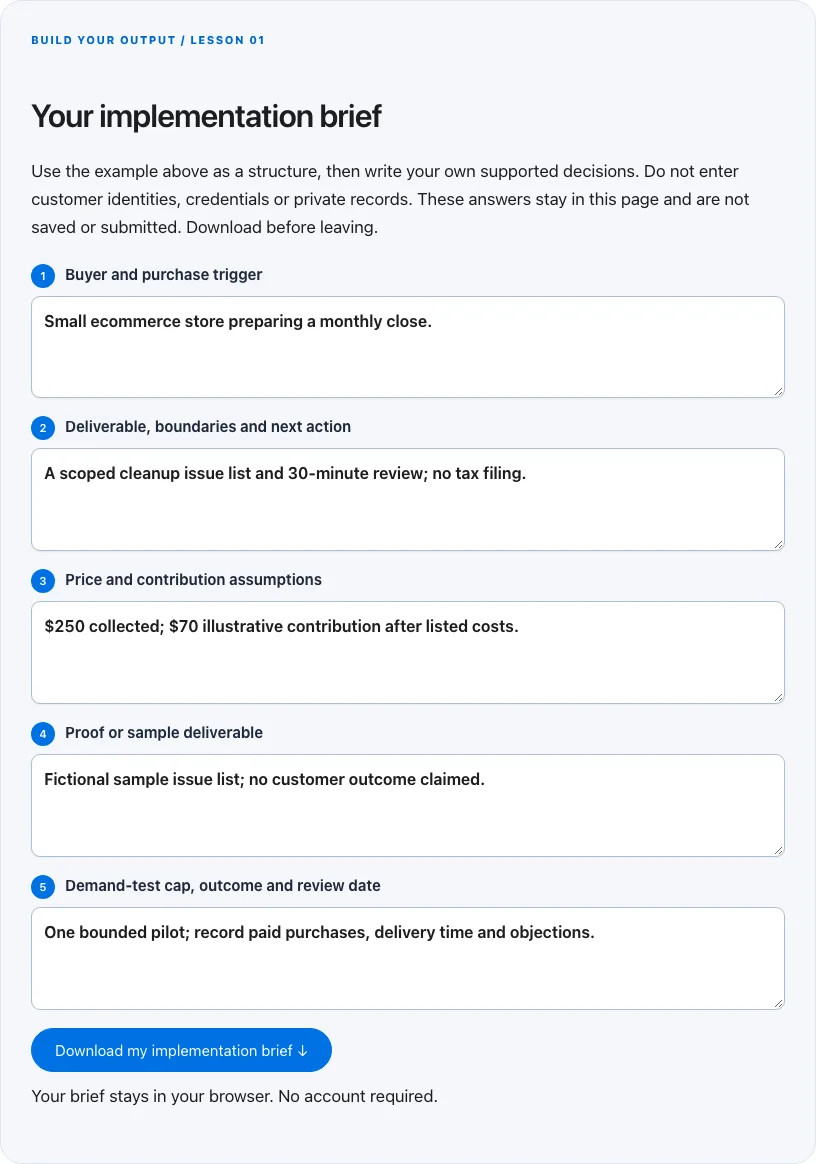
Troubleshoot before you add more tools
| What you notice | What to check next |
|---|---|
| People misunderstand the offer | Ask five relevant readers to describe what arrives. Rewrite the deliverable before changing button colors. |
| Sales increase but cash gets tighter | Reconcile refunds, delivery time and payment timing; a growing negative-contribution offer needs correction. |
| The test has very little traffic | Do not label the offer a failure from a few views. Diagnose access to qualified prospects and record uncertainty. |
BUILD YOUR OUTPUT / LESSON 01
Your implementation brief
Use the example above as a structure, then write your own supported decisions. Do not enter customer identities, credentials or private records. These answers stay in this page and are not saved or submitted. Download before leaving.
Your brief stays in your browser. No account required.
OPTIONAL TOOLS / CHOOSE FOR THE JOB
Tools that fit this lesson
Affiliate disclosure: I may earn a commission if you purchase through these affiliate links. You do not need to buy a tool to complete this lesson. These are fit-based options, not a claim that I personally use every product or that a product caused our companies’ results. Check current features, pricing and terms before buying.
Systeme.io — explore the tool ↗
A candidate for a simple funnel, asset-delivery and email workflow. Verify the exact plan capabilities and consent handling. Skip it if your current website and email tools already complete the job.
GoHighLevel — explore the tool ↗
Consider a CRM-centered workflow when you need pipeline ownership and connected follow-up. Map the states first and test the relevant integrations. A simpler tool may be enough for a single page or sequence.
DropFunnels — explore the tool ↗
An option to evaluate for website and funnel building. Check editing, integration, accessibility and export needs against your actual page brief; existing WordPress hosting may already be sufficient.
Collect.chat — explore the tool ↗
An optional conversational intake interface. Test keyboard access, mobile layout, accepted-record routing and privacy. A conventional accessible form may be clearer for a short enquiry.
Free starting point: plan the workflow in a document or spreadsheet and test it using tools you already have. Buy a capability only when a verified constraint justifies it. Read the full affiliate disclosure.
Done means verified.
0 / 6 checkedCheck a line only when you have the evidence. A downloaded plan is a starting point; it does not prove that the live workflow works.
Verify all six checks to mark complete.
Review the evidence, then continue
Keep the output you created, the test date, the source of truth and the result of each completion check. Mark a system Live after the path is deployed and tested. Mark it Working only when adequate recent evidence meets a defined outcome target. If the lesson does not fit your business or stage, write the reason and a review trigger instead of pretending it is complete.
Choose one next action, assign an owner and set a review date. More tools, more traffic or more automation are not automatically the next step. The next lesson builds on this artifact, so resolve missing inputs or failed checks before expanding the system.
Go deeper when you need it
Primary references and further reading
Provider interfaces, limits and policies can change. Check the current official instructions for your account before implementing. This article teaches an operating method; it does not independently certify compliance or business performance.