Free implementation guide / 05
Validate an Offer Before You Spend on Marketing
Turn a promising idea into a small, testable offer—and learn what customers will actually commit to.
A testable offer backed by customer evidence.
A customer segment, access to relevant prospects, and a place to record what they say.
Jump to the working checklist ↓
Aaron Peden
Founder & CMO · Practical business education
The outcome
Leave with a one-page offer, a short interview plan, and a decision rule for a small paid test.
This playbook is general educational guidance. The worked example is hypothetical, not a claim about Aaron’s personal results.
01Choose a customer and a costly problem
“Small businesses” is too broad to test. Choose a group you can reach and a problem you can observe: independent repair shops that lose bookings when nobody answers the phone, for example. Write down when the problem occurs, what they currently do, and what it costs in time, money or risk.
Separate the buyer from the user. An employee may dislike a workflow while the owner controls the budget. Speak to both where relevant. List the assumptions that would make the offer fail: the problem is infrequent, the buyer cannot pay, or a cheaper workaround is good enough.
02Ask about behavior before pitching
Have five to ten short conversations as an initial learning exercise, not a statistically representative study. Ask: “Tell me about the last time this happened.” “What did you try?” “Who approved the spend?” “What would have made that solution worth keeping?”
Record exact phrases with permission. Avoid “Would you buy this?” or leading questions that invite politeness. A recent purchase, a documented workaround, or willingness to introduce you to the decision-maker is stronger evidence than praise. Do not secretly record people or collect information you do not need.
SEE THE ACTUAL EXAMPLE
See a filled offer test brief
Your action: Replace the example with your own buyer, scope and decision rule, then download the brief.
03Write an offer someone can understand
Use this structure: For [specific customer], we provide [specific deliverable] to help with [observable problem], within [scope and timing], for [price]. State exclusions and what the customer must supply. Promise the work you control; do not guarantee commercial outcomes you cannot control.
Make the first version narrow enough to deliver manually. A two-week setup service can be easier to test than an unfinished platform. Write the cancellation and refund expectations before taking money. Do not accept an order you cannot responsibly fulfill.
04Ask for a proportionate commitment
Move from opinion to action: a scheduled assessment, a signed pilot agreement, or a paid pilot with clear terms. Match the commitment to the stage of the product. If delivery is not ready, use an honestly labeled waitlist instead of pretending the product exists.
Track invitations, qualified conversations, offers made, commitments and reasons for declining. Keep a separate note of whether people can afford the offer and whether you can deliver it profitably. Demand alone does not prove a workable business.
05Decide before you spend
Choose a time limit, a maximum affordable loss and an evidence threshold in advance. The threshold is your test design, not an industry benchmark. For example: ten qualified conversations, three pilot commitments and acceptable delivery economics within two weeks.
If people describe the problem but decline your offer, investigate the reason. Revise one meaningful variable—customer, scope, price or channel—then run another bounded test. If the problem is weak, stop. A small failed test can prevent an expensive campaign.
Worked example — hypothetical
A hypothetical bookkeeping service interviews ten independent studios. Six describe late invoicing, four request a proposal, and two buy a $150 invoice-cleanup pilot. The founder’s prewritten threshold was three paid pilots. Two sales show some willingness to pay but do not meet that rule. The next step is to examine objections and delivery time, not declare product-market fit or buy a month of ads.
Download the printable worksheet ↓
The worksheet opens in a browser and can be printed or saved as PDF. No email address is required.
Common mistakes
- Interviewing only friends who want to encourage you.
- Treating clicks, likes or waitlist entries as paid demand.
- Changing the offer halfway through the test without documenting it.
- Ignoring delivery costs while celebrating initial sales.
Your next action
Write one offer sentence today. Ask three potential buyers about the last time they experienced the problem before showing them your solution.
The field guide / A practical framework
Make the idea earn the investment.
- 01Listen
Identify a specific customer problem.
- 02Shape
Write one clear, testable offer.
- 03Test
Ask for a real commitment.
- 04Decide
Use the evidence to continue or adjust.
- 01Choose one customer
Name the buyer and the moment they need help.
- 02Find recent evidence
Record the last occurrence and current workaround.
- 03Ask for commitment
Use a clear, honest next step to test demand.
- 04Decide from behavior
Proceed, revise or stop against a written rule.
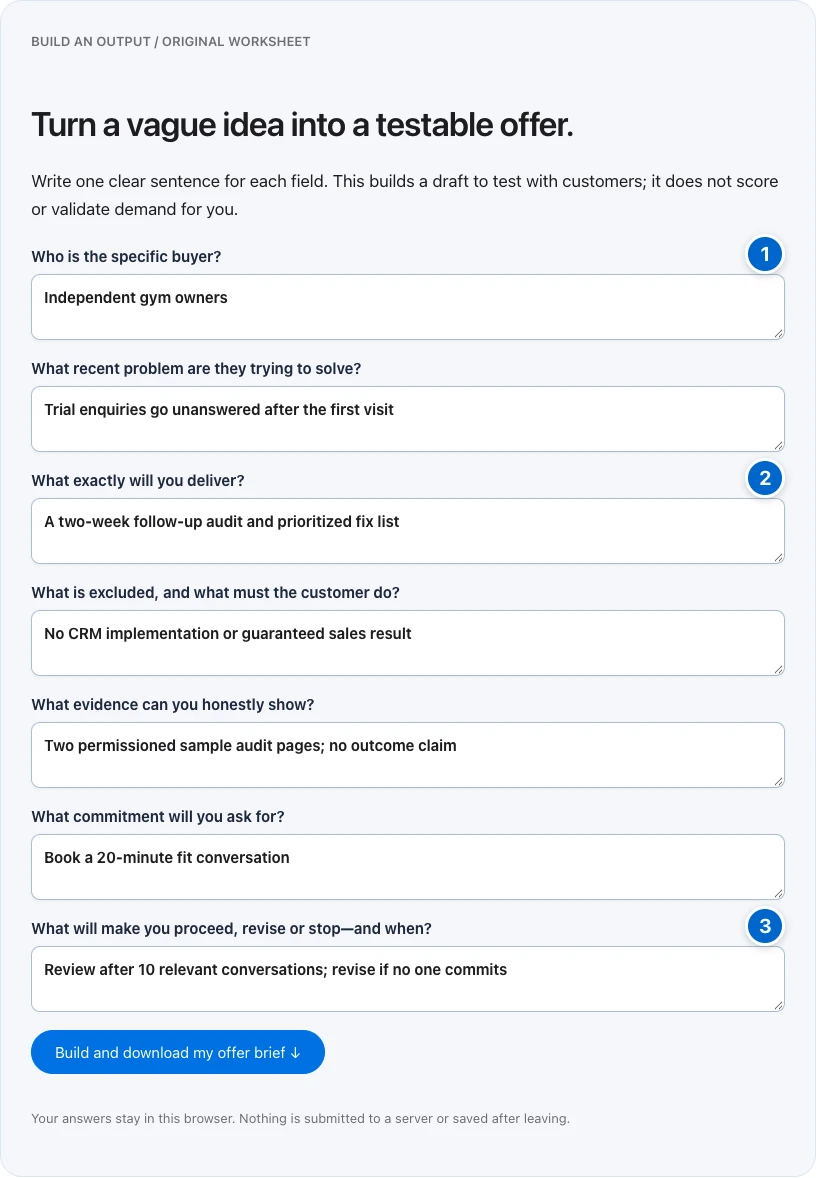
BUILD AN OUTPUT / ORIGINAL WORKSHEET
Turn a vague idea into a testable offer.
Write one clear sentence for each field. This builds a draft to test with customers; it does not score or validate demand for you.
Your answers stay in this browser. Nothing is submitted to a server or saved after leaving.
Make the idea concrete.
A service provider hears that gym owners lose time following up with trial members. The first test is a scoped follow-up audit, not a full software build. Record actual willingness to take a next step before expanding the offer.
Done means verified.
Check each item as you verify it. Progress stays in this page; download your checklist before leaving.