Marketing Blueprint / Lesson 13 of 16
Turn Real Customer Evidence Into Social Proof That Supports the Sale
Lesson 13 of 16. A permissioned evidence library and claim-to-proof placement plan. Six implementation steps, a worked example, an editable brief and a completion checklist.
By Aaron Peden · Published · Updated October 27, 2026
LESSON 13 / TRUST
What you will build: A permissioned evidence library and claim-to-proof placement plan.
Good proof reduces a specific uncertainty. A buyer asking whether you understand their workflow needs something different from a buyer asking whether a product works on their device. Collect evidence deliberately, preserve context and place it beside the claim it supports. A wall of logos without explanations often leaves the important question unanswered.
Company milestones and awards can establish background credibility, but they do not guarantee a reader’s results. A testimonial is one person’s account, not a universal promise. This lesson builds a source-and-permission register so useful proof can be reused accurately across pages, ads and sales conversations.
- 01List the claims that need support
- 02Collect real sources and permissions
- 03Build a case study with clear scope
- 04Place proof beside the relevant decision
- 05Check claims, accessibility and technical presentation
- 06Maintain and evaluate the evidence library
Before you start
Bring the working brief from the previous lesson. Keep your current offer, customer definition, authoritative sources and delivery constraints available. If a prerequisite is incomplete, return to that lesson before connecting a live workflow.
Use a private draft or safe testing environment for implementation. The examples below use fictional data and do not describe customer results at Rocktomic, YourPeptideBrand or WellStaq. Nothing in this lesson launches ads, sends outreach or changes your accounts.
BUILD STEP 01
List the claims that need support
Review the offer page and sales objections. Identify factual claims about delivery, experience, capability, customer outcomes and comparative advantages. For each claim, write the uncertainty it should resolve and the strongest appropriate evidence. A process claim may need a real demonstration; a customer outcome may need a permissioned case study with a defined period. Remove unsupported superlatives rather than searching for a badge that vaguely resembles proof.
Verify before moving on: Every important claim has a named evidence need and unsupported claims are visible.
BUILD STEP 02
Collect real sources and permissions
Use original customer statements, project records, public award pages or a documented demonstration. Preserve the source, date, context and permission to publish names, logos, images and quotations. Do not assume a public social post authorizes every commercial reuse. Check confidentiality obligations before capturing dashboards or messages. If permission is pending, keep the item unpublished or anonymize it only when that is appropriate and authorized. Never use AI-generated testimonials, invented customer identities or fabricated review scores.
Verify before moving on: The register shows what can be published, where it came from and what use was approved.
BUILD STEP 03
Build a case study with clear scope
Describe the starting situation, intervention, observation period, result and limitations. Define the numerator and denominator for percentages and distinguish revenue, contribution and cash. Explain the team’s role rather than attributing a company-wide outcome to one person or tool without evidence. If multiple changes occurred, acknowledge that you cannot isolate their individual effects. Include relevant costs and exclusions when they materially change the interpretation. Keep the customer’s approval tied to the final version.
Verify before moving on: A reader can understand what changed, how it was measured and what cannot be concluded.
BUILD STEP 04
Place proof beside the relevant decision
Put a sample deliverable near the deliverable description, a relevant customer quote near a common concern and a verified award beside its actual description. Keep captions readable and logos proportionate. Link to a source where appropriate. Avoid making a founder photo, award or aggregate company number appear to endorse an unrelated product recommendation. On mobile, keep the claim and its evidence close enough that the relationship remains clear.
Verify before moving on: Each proof item answers a nearby buying question and does not imply an unrelated endorsement.
BUILD STEP 05
Check claims, accessibility and technical presentation
Inspect quotes for accurate wording and meaningful context. Check image rights, alt text, contrast and full-size access for detailed screenshots. Mask sensitive account or customer data before publishing. Avoid adding review structured data unless the content and property meet the applicable requirements; decorative stars are not a legitimate rating dataset. Test source links and confirm old dates or awards are not presented as current-year wins.
Verify before moving on: The public page preserves accuracy, permissions, context and readable evidence on a phone.
BUILD STEP 06
Maintain and evaluate the evidence library
Assign review dates for time-sensitive claims and a process for withdrawing permission or correcting a quote. Track where each item appears so a correction can be applied consistently. Ask prospects which uncertainty remains after reading the page. Evaluate changes with qualified outcomes and a sensible observation window; adding a testimonial does not establish a causal conversion lift by itself. Retire irrelevant proof rather than accumulating every badge indefinitely.
Verify before moving on: The evidence has an owner and every reuse can be found, corrected or removed.
Use a claim-to-evidence register
Give each proof item a stable identifier and fields for claim, source, date, measurement period, permission, allowed placements and review owner. For a numerical result, retain the underlying calculation and exclusions in an appropriate private record; publish the relevant method without exposing sensitive customer data. For a screenshot, preserve an original and a redacted publishing version. A cropped quote must keep its meaning. When a customer or provider changes the allowed use, search the placement register and update every public version. This prevents an old sales deck, ad or video description from continuing a claim that has already been corrected on the website.
WORKED EXAMPLE / FICTIONAL INPUTS
See how the decisions fit together
Illustrative case-study structure: a fictional agency reduced its median proposal preparation time from 120 to 75 minutes over a defined four-week pilot. The sample includes ten comparable proposals and excludes unusually complex projects under a documented rule. The agency also changed its template and approval process, so the case study does not claim AI alone caused the change. The public proof includes the measurement method and customer permission. This is an example of presentation, not a real client result or an expected performance promise.
Replace these assumptions with your own supported inputs. Keep unknowns visible and avoid treating this example as a benchmark, a forecast or a result you should expect.
A starting specification you can copy
Claim → buyer uncertainty → evidence type → source
Permission → approved name/logo/quote/image + allowed channels
Case study → baseline / change / period / result / method / limits
Placement → page URL + nearby claim + caption
Maintenance → owner + review date + correction/removal route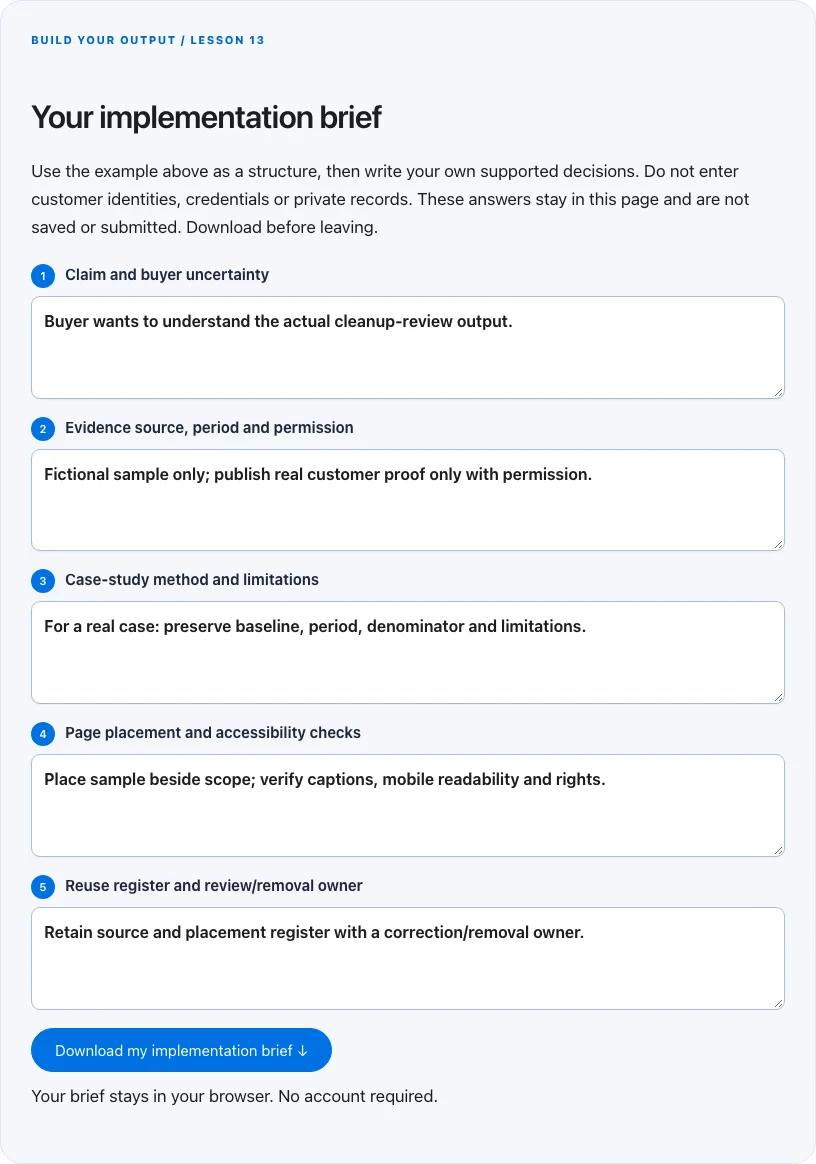
Troubleshoot before you add more tools
| What you notice | What to check next |
|---|---|
| The proof is impressive but unrelated | Replace it with evidence that answers the actual objection beside the CTA. |
| A percentage has no denominator or period | Add the method and scope or remove the number. |
| A customer withdraws permission | Use the reuse register to remove the item from every active placement. |
BUILD YOUR OUTPUT / LESSON 13
Your implementation brief
Use the example above as a structure, then write your own supported decisions. Do not enter customer identities, credentials or private records. These answers stay in this page and are not saved or submitted. Download before leaving.
Your brief stays in your browser. No account required.
OPTIONAL TOOLS / CHOOSE FOR THE JOB
Tools that fit this lesson
Affiliate disclosure: I may earn a commission if you purchase through these affiliate links. You do not need to buy a tool to complete this lesson. These are fit-based options, not a claim that I personally use every product or that a product caused our companies’ results. Check current features, pricing and terms before buying.
Synthesys — explore the tool ↗
An AI voice/video option for a disclosed demonstration or explainer. Verify rights, identity permissions, captions and every claim. It is never a way to manufacture a testimonial; a real screen recording may be more useful.
Free starting point: plan the workflow in a document or spreadsheet and test it using tools you already have. Buy a capability only when a verified constraint justifies it. Read the full affiliate disclosure.
Done means verified.
0 / 6 checkedCheck a line only when you have the evidence. A downloaded plan is a starting point; it does not prove that the live workflow works.
Verify all six checks to mark complete.
Review the evidence, then continue
Keep the output you created, the test date, the source of truth and the result of each completion check. Mark a system Live after the path is deployed and tested. Mark it Working only when adequate recent evidence meets a defined outcome target. If the lesson does not fit your business or stage, write the reason and a review trigger instead of pretending it is complete.
Choose one next action, assign an owner and set a review date. More tools, more traffic or more automation are not automatically the next step. The next lesson builds on this artifact, so resolve missing inputs or failed checks before expanding the system.
Go deeper when you need it
Primary references and further reading
Provider interfaces, limits and policies can change. Check the current official instructions for your account before implementing. This article teaches an operating method; it does not independently certify compliance or business performance.