Free implementation guide / 06
Build a Practical Plan for Your First Customers
Choose one reachable audience, one primary channel, and a weekly routine you can learn from.
One bounded acquisition test with a review rule.
One defined offer, one reachable audience, and a time/spend limit.
Jump to the working checklist ↓
Aaron Peden
Founder & CMO · Practical business education
The outcome
Build a two-week customer acquisition plan with a clear activity budget, a simple sales path and a review date.
This playbook is general educational guidance. The worked example is hypothetical, not a claim about Aaron’s personal results.
01Start with a reachable segment
Choose a segment using more than demographics. Specify the triggering event, buying situation and person who can decide. “New studio owners setting up their first booking process” suggests places to find people and questions to ask. “Everyone who needs software” does not.
List twenty potential conversations or relevant communities you can approach appropriately. Use public business information and permitted channels. Avoid bulk unsolicited messages, scraped personal lists or automated outreach that ignores consent and platform rules.
02Pick a channel that matches buying behavior
If buyers already search for the solution, a useful search-focused page may help. SEO takes time and involves publishing, maintenance and measurement costs; it is not instant free traffic. Answer a specific buying question before trying to cover an entire topic.
If the problem is new or hard to describe, conversations, introductions or a small workshop may teach you faster. Paid ads can test a clear offer quickly, but only with a bounded budget and a working conversion path. Choose one primary channel for the first test so you can interpret the result.
SEE THE ACTUAL EXAMPLE
Separate traffic, enquiries and customers
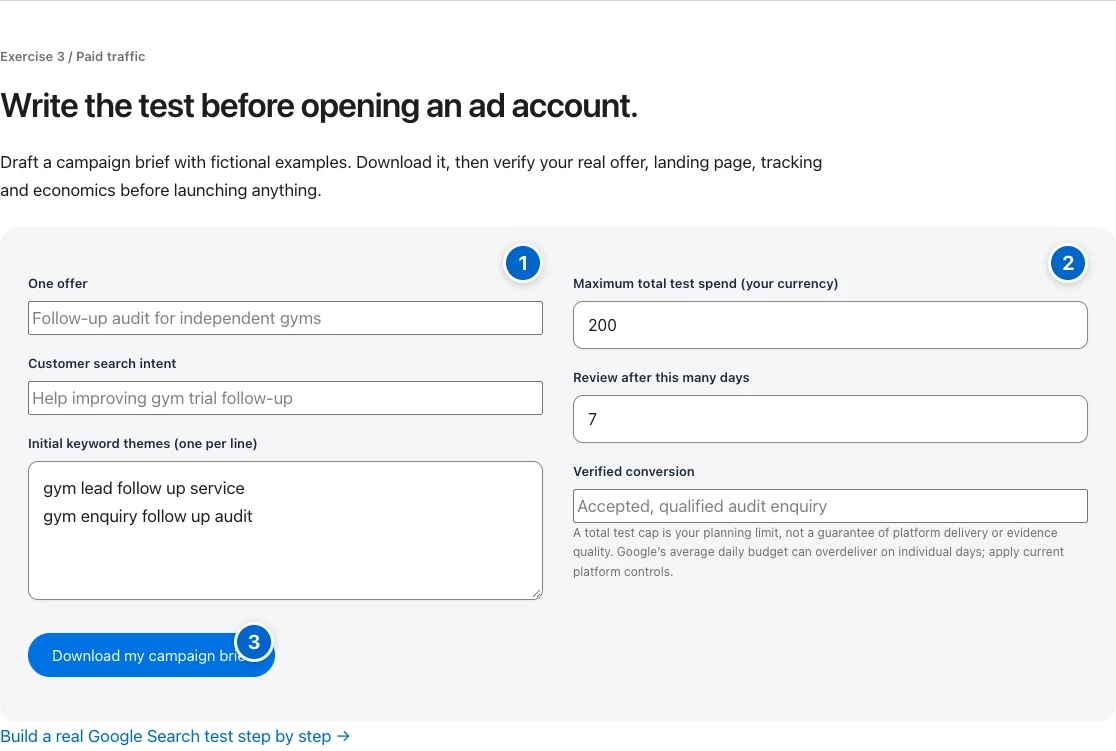
Your action: Write your bounded test, then record visits, accepted enquiries and customers separately.
Open the pictured tool or exercise →
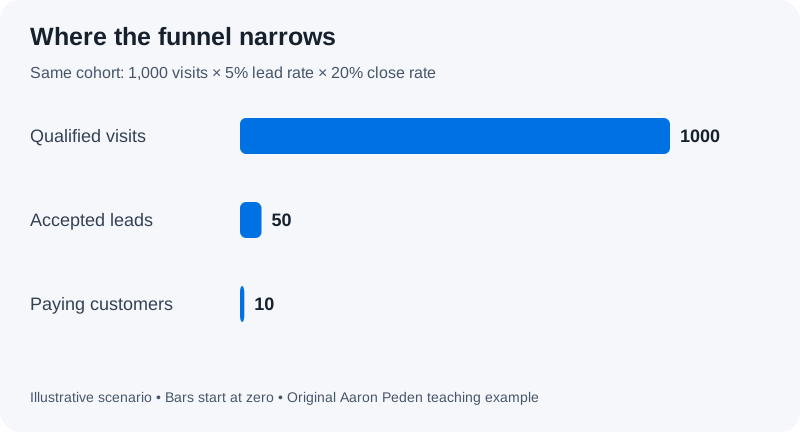
| Stage | Count |
|---|---|
| Qualified visits | 1000 |
| Accepted leads | 50 |
| Paying customers | 10 |
03Build the shortest useful path
Write down the steps: introduction or discovery → relevant offer → qualified conversation → clear proposal → payment and delivery. Give each step one next action. Remove extra choices that do not help the buyer decide.
Prepare a brief explanation, an honest scope and a response to likely objections. If a prospect is not a fit, say so. A first customer who cannot benefit from the offer is not a useful success metric. Establish how and when you will follow up, and stop when asked.
04Turn activity into a weekly plan
Reserve time for finding prospects, having conversations, following up and delivering. Put an owner and a date beside each action. A modest schedule you can maintain is more useful than a daily quota that collapses after two days.
Track the same definitions every week: qualified contacts, replies, qualified conversations, offers, new paying customers, collected revenue and attributable acquisition costs. Separate new customers from repeat purchases. Record the source as “unknown” when you cannot establish it.
05Find the bottleneck before adding volume
No replies can mean poor targeting, weak relevance, deliverability trouble or an inappropriate channel. Conversations without proposals can mean weak qualification. Proposals without sales may point to price, trust, scope or timing. Ask for evidence rather than guessing from a single lost sale.
At the review date, change one bottleneck and repeat the test. For SEO, early feedback may be whether the page is useful and discoverable, not immediate customers. For advertising, stop at the loss limit. Keep fulfillment capacity in the plan so more demand does not damage delivery.
Worked example — hypothetical
A hypothetical design service plans twenty relevant introductions over two weeks and spends $120 on a small workshop. Eight people reply, five are qualified, three request a proposal, and one buys. Cash-only acquisition cost is $120. Including six hours of acquisition work valued at $25 per hour brings modeled acquisition cost to $270. Neither figure proves the channel will scale. The founder tests clearer proposals before doubling outreach.
Download the printable worksheet ↓
The worksheet opens in a browser and can be printed or saved as PDF. No email address is required.
Common mistakes
- Starting five channels and learning little about any of them.
- Counting every reply as a qualified opportunity.
- Ignoring the value of founder time.
- Increasing spend before checking conversion and fulfillment.
Your next action
Choose one channel for the next two weeks. Put three customer conversations and a review appointment on your calendar.
The field guide / A practical framework
From attention to a customer.
- 01Reach
Choose one channel and one audience.
- 02Offer
Make the next step clear and relevant.
- 03Convert
Measure customers, not just clicks.
- 04Learn
Compare acquisition cost with contribution.
- 01Reach the right people
Choose one audience and one channel.
- 02Start conversations
Record relevant replies, not impressions alone.
- 03Make a clear proposal
State scope, price and the next step.
- 04Count paying customers
Review cost and time alongside customers won.
TRY YOUR NUMBERS / PLANNING MODEL
Can this funnel support your acquisition cost?
Use one period, one cohort and one currency. Defaults are illustrative assumptions, not your company’s results.
Formula: visits × lead rate × close rate = expected customers. Contribution after acquisition = customers × (net revenue − variable cost) − total acquisition cost. This is not net profit: fixed overhead, tax, financing and cash timing are excluded. Include attributable sales labor, creative and tools in acquisition cost; do not count a cost twice. Fractional customers are expected values, not observed people. Inputs stay in this browser and are not saved.
Make the idea concrete.
A local service business chooses one service, one area and one relevant landing page. Its test sheet tracks outreach or paid visits, qualified inquiries and customers separately. It changes one variable at the review date.
Done means verified.
Check each item as you verify it. Progress stays in this page; download your checklist before leaving.