Technical tutorial / Marketing Strategy
Build a 14-Day Marketing Test Before You Buy More Traffic
Turn a business goal into one bounded acquisition experiment with a budget, evidence log and written decision rule.
By Aaron Peden · Published · Updated October 27, 2026
Build this: A one-page test brief that tells you what to do, what to measure and when to stop.
Before you start: One real offer, access to prospective customers, and a maximum amount of time and money you can lose.
A marketing plan becomes useful when it changes what you do on Monday. “Grow the business” does not tell you which customer to contact, what to offer or how to judge the result. This tutorial produces a two-week learning test, not a promise that two weeks is enough to establish demand. Long sales cycles need a longer observation window even if acquisition activity stops after day fourteen.
Start with the uncertainty that could invalidate your next investment. If you have never sold the offer, willingness to commit is usually more informative than a target number of impressions. If sales already happen, the constraint may instead be delivery capacity, cost, follow-up or measurement.
1. Choose one decision, not a list of channels
Write the decision you need to make at the end: continue offering a paid audit to independent gym owners, revise the scope, or stop this version. List the evidence you currently have and the assumptions you are making. Separate actual transactions, customer statements and your own guesses. An enthusiastic comment is weaker evidence than a paid order, but a payment still does not establish repeatable profitable acquisition.
Pick one uncertainty you can investigate without changing the entire business. “Will owners book a qualified discovery call for this defined audit?” is testable. “Will marketing work?” is not. Record the date, owner and source for each observation so a later review can distinguish memory from evidence.
2. Define the customer and the buying moment
Name a narrow buyer, the problem they recently experienced and what they currently do about it. Interview questions should ask about the last occurrence, the workaround and the cost of leaving it unresolved. Avoid asking whether someone likes your idea before you understand their existing behavior. If you cannot reach the decision-maker, record that as a constraint rather than assuming a broad audience will compensate.
Keep the initial segment small enough that the message and offer can stay consistent. For example, independent gyms with a trial follow-up problem are more coherent than every small business needing software. Do not invent facts about a prospect to make the outreach sound personal.
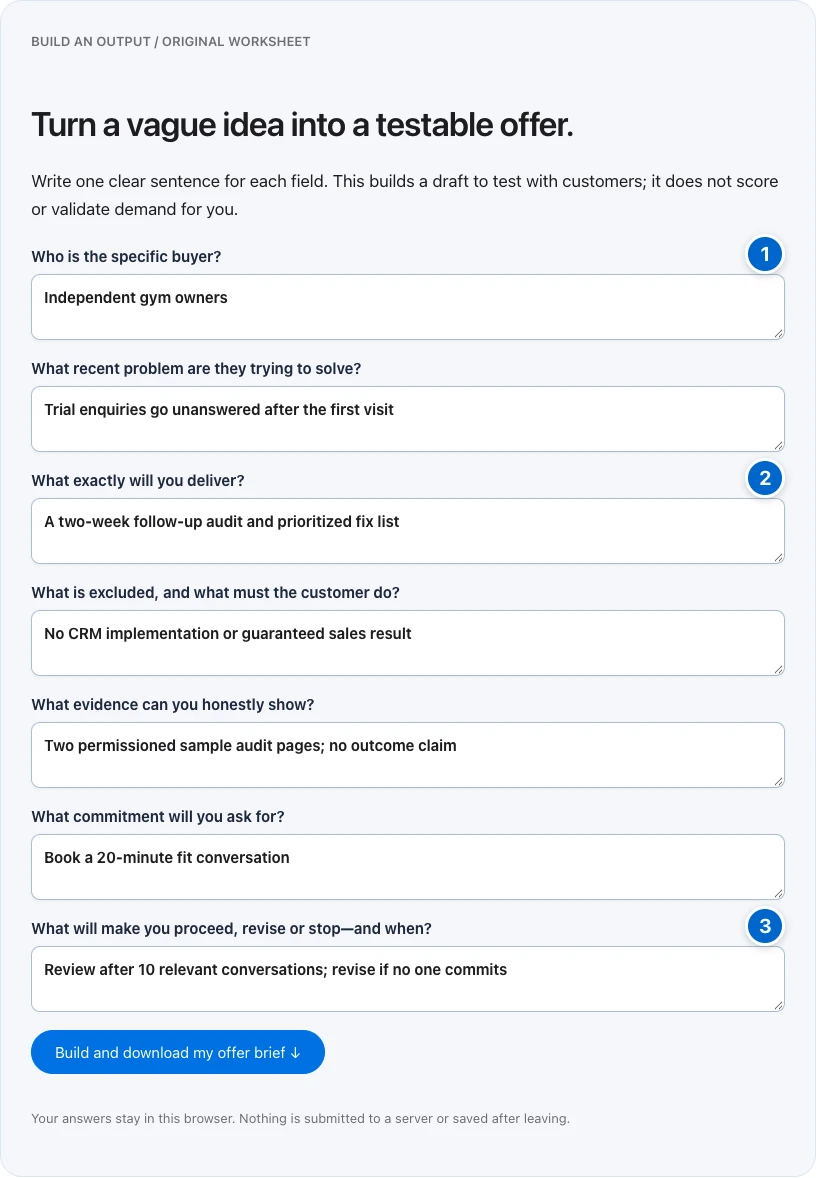
See the actual example
3. Write the offer and the commitment
State the deliverable, price or pricing process, exclusions, customer responsibilities and honest delivery timing. Then choose one action that represents forward movement: a qualified call, a signed pilot or payment under clear terms. Use the offer brief pictured below to write the buyer, deliverable and decision rule. A waitlist join is interest; do not report it as a paying customer.
Check delivery feasibility before accepting money. The test is not permission to sell a service you cannot supply. If the offer is not ready to transact, use a transparent research or early-access invitation and measure that narrower outcome. Label every result according to what the person actually did.
4. Choose a channel and cap the exposure
Use one channel where you can reach the segment and observe the response. Record the activity planned, person responsible, working hours and cash limit. Include landing-page preparation, creative and attributable labor in the test economics. For ads, verify current platform controls because a daily average is not necessarily a hard daily cap.
A time cap and a spending cap are different controls. Stopping work after fourteen days does not automatically stop a subscription or campaign. List the systems that must be paused, who will pause them and the date. Do not treat a planning worksheet as a platform-enforced spending limit.
Worked example — illustrative or dated as stated
Illustrative test: offer a two-week follow-up audit to independent gyms. Allocate six working hours and at most $200 cash. Record relevant conversations and explicit commitments separately. At the review, three accepted calls and no purchases would establish three calls—not a validated profitable business. Examine the call notes, scope objections and delivery requirements before choosing the next test.
5. Set up an evidence log before starting
Create columns for date, activity, audience, source, accepted enquiries, qualified conversations, offers and customers. Use a non-sensitive internal reference to reconcile records. Put personal details in the approved customer system, not an analytics event or public spreadsheet. Test the entire response path before the first activity so a broken form cannot quietly invalidate the experiment.
Write a proceed, revise and stop rule in advance. A useful rule can combine evidence quality, contribution and delivery capacity. Ten conversations is an illustrative activity target, not statistical proof. If few qualified buyers respond, first check reach and message fit before claiming the market has rejected the offer.
6. Review the bottleneck and choose one change
At the review, compare the log with received enquiries and sales records. Describe what happened at each handoff. Were people reached? Did relevant people respond? Did they understand the offer? Did they buy, and could you deliver? Record unknowns, including delayed sales, incomplete attribution and unrecorded costs.
Choose one next change that follows from the evidence. If conversations happen but the scope is misunderstood, revise the offer before buying more reach. If demand exists but delivery fails, fix fulfillment. Keep the original version and results so the next test has a baseline rather than a rewritten memory.
YOUR IMPLEMENTATION WORKSHEET
Build your working document.
Enter planning notes without customer identities or secret values. Your answers stay in this browser and are not saved. Download the completed brief before leaving.
No information is submitted to a server.
Completion checklist
0 / 8 checkedCheck only what you have verified. Download before leaving; this page does not save your progress.
Sources and scope
Primary-source guidance checked October 27, 2026. Interfaces and policies can change; consult the linked current source. Practice screenshots and modeled examples are labeled and are not client campaign results.