Marketing Blueprint / Lesson 14 of 16
Launch Google and Meta Ads as a Controlled Business Test
Lesson 14 of 16. A bounded campaign brief with verified conversion tracking, unit economics and explicit review rules. Six implementation steps, a worked example, an editable brief and a completion checklist.
By Aaron Peden · Published · Updated October 27, 2026
LESSON 14 / ACQUISITION
What you will build: A bounded campaign brief with verified conversion tracking, unit economics and explicit review rules.
Paid traffic multiplies the path you already built. If the page loses enquiries, the offer is unclear or the business cannot deliver, advertising makes the problem more expensive. Finish the offer, page, tracking and relevant proof before launching a test. Then choose one channel and one clear hypothesis rather than opening every platform at once.
The goal of a first test is evidence about a specific customer journey within a loss you can afford. It is not a promise of profitable scaling. This lesson prepares a campaign brief and QA process; no ad is launched and no spend is authorized by completing the worksheet.
- 01Calculate an affordable acquisition test
- 02Choose the channel and buying situation
- 03Prepare accurate creative and a matched page
- 04Verify conversion and exclusion behavior
- 05Launch only the approved bounded test
- 06Review mature outcomes before scaling
Before you start
Bring the working brief from the previous lesson. Keep your current offer, customer definition, authoritative sources and delivery constraints available. If a prerequisite is incomplete, return to that lesson before connecting a live workflow.
Use a private draft or safe testing environment for implementation. The examples below use fictional data and do not describe customer results at Rocktomic, YourPeptideBrand or WellStaq. Nothing in this lesson launches ads, sends outreach or changes your accounts.
BUILD STEP 01
Calculate an affordable acquisition test
Use the contribution model from Lesson 01 to estimate the amount available for acquisition while retaining your required contribution. Distinguish a target CAC from a hard break-even boundary and include sales labor, creative and attributable tools where relevant. Write an explicit total test-loss cap, not only a daily budget. Model cash timing and delivery capacity. Avoid funding a first test from speculative lifetime value when you have no retention evidence.
Verify before moving on: The brief contains the economic assumptions, target, total loss cap and person authorized to spend.
BUILD STEP 02
Choose the channel and buying situation
For Search, map queries to intent and the matched landing page. Separate branded, competitor, informational and high-intent commercial queries where they need different decisions. For Meta, define the audience hypothesis, creative angle, placement needs and exclusions while following platform policies. Do not assume identical targeting or attribution across channels. Check whether your business or product has category-specific advertising restrictions before creating assets. Start with the smallest coherent campaign that can answer the question.
Verify before moving on: One campaign hypothesis connects audience or query, offer, creative, page and business outcome.
BUILD STEP 03
Prepare accurate creative and a matched page
Use the actual offer, deliverable and evidence. Make headline, image or video, CTA and destination consistent. Do not use fake testimonials, misleading before-and-after images or unsupported income or health claims. Give each creative variation a clear hypothesis instead of changing every element at once. Check the mobile destination, price, required conditions and form path. A platform approving an ad does not prove the claim is true or the campaign will be profitable.
Verify before moving on: Every ad promise is fulfilled by the destination and important limitations remain visible.
BUILD STEP 04
Verify conversion and exclusion behavior
Confirm the correct property, conversion event and successful trigger from Lesson 04. Test a valid submission, rejection, duplicate action and purchase state as applicable. Keep test outcomes out of business reporting. Review whether the platform is optimizing toward the true outcome or a weaker proxy such as a click. Use appropriate consent handling, avoid personal information in URLs and analytics fields, and check audience exclusions for existing customers when that matches the objective.
Verify before moving on: One accepted action is measured correctly and failures do not create successful conversions.
BUILD STEP 05
Launch only the approved bounded test
Review geography, schedule, language, bidding, budget, destination, conversion settings and account billing before activation. For Search, inspect query eligibility and negative keywords; for Meta, inspect placements and creative previews. Keep a launch receipt with the approved version and total budget. Watch early technical behavior without making hourly strategic changes from tiny samples. Stop promptly for broken tracking, wrong geography, policy problems or an unusable customer path.
Verify before moving on: The live campaign matches the approved brief and cannot silently exceed the intended test boundary.
BUILD STEP 06
Review mature outcomes before scaling
Allow for your actual conversion and sales delay. Reconcile spend, accepted enquiries, qualified opportunities, customers and contribution. Inspect search terms or creative-level delivery for obvious mismatch, but do not mistake a cheap click for a valuable customer. State sample-size limitations and attribution gaps. Increase spend only when performance, cash and fulfillment capacity support it. Preserve the previous settings and define what would reverse the scale decision.
Verify before moving on: The decision to stop, revise or expand cites business outcomes from a consistent mature cohort.
Separate operational stops from business decisions
Operational stops include broken destinations, wrong geography, duplicate billing, unavailable inventory, policy problems and incorrect conversion events; fix or pause these immediately. Business decisions require a declared observation window and mature outcomes. A slow first day is not automatically evidence that the offer failed, and a lucky first sale is not enough to justify scaling. Keep the total approved test cap visible alongside the platform’s budget settings. Account for reporting delay and cash timing. Preserve campaign and creative versions so the review can connect outcomes to the actual setup. Budget increases need a fresh capacity and contribution check rather than a rule that simply doubles spend after one favorable metric.
WORKED EXAMPLE / FICTIONAL INPUTS
See how the decisions fit together
Fictional economics: each order collects $200 and has $80 delivery cost plus $20 other variable cost. Contribution before acquisition is $100. If you want $40 retained contribution, target CAC is $60. A $600 test with ten customers would match that target before fixed costs and tax; five customers would mean $120 CAC and negative contribution after acquisition. These are planning scenarios, not a required test size or forecast. Choose a test cap you can afford and account for the time needed to observe qualified customer outcomes.
Replace these assumptions with your own supported inputs. Keep unknowns visible and avoid treating this example as a benchmark, a forecast or a result you should expect.
A starting specification you can copy
Objective: [accepted and qualified business outcome]
Hypothesis: [audience/query] + [offer] + [matched page]
Economics: collected − variable costs − target retained = target CAC
Test boundary: total spend/loss cap + dates + authorized owner
QA: geography / creative / destination / conversion / billing / consent
Review: mature cohort + qualified customers + contribution + capacity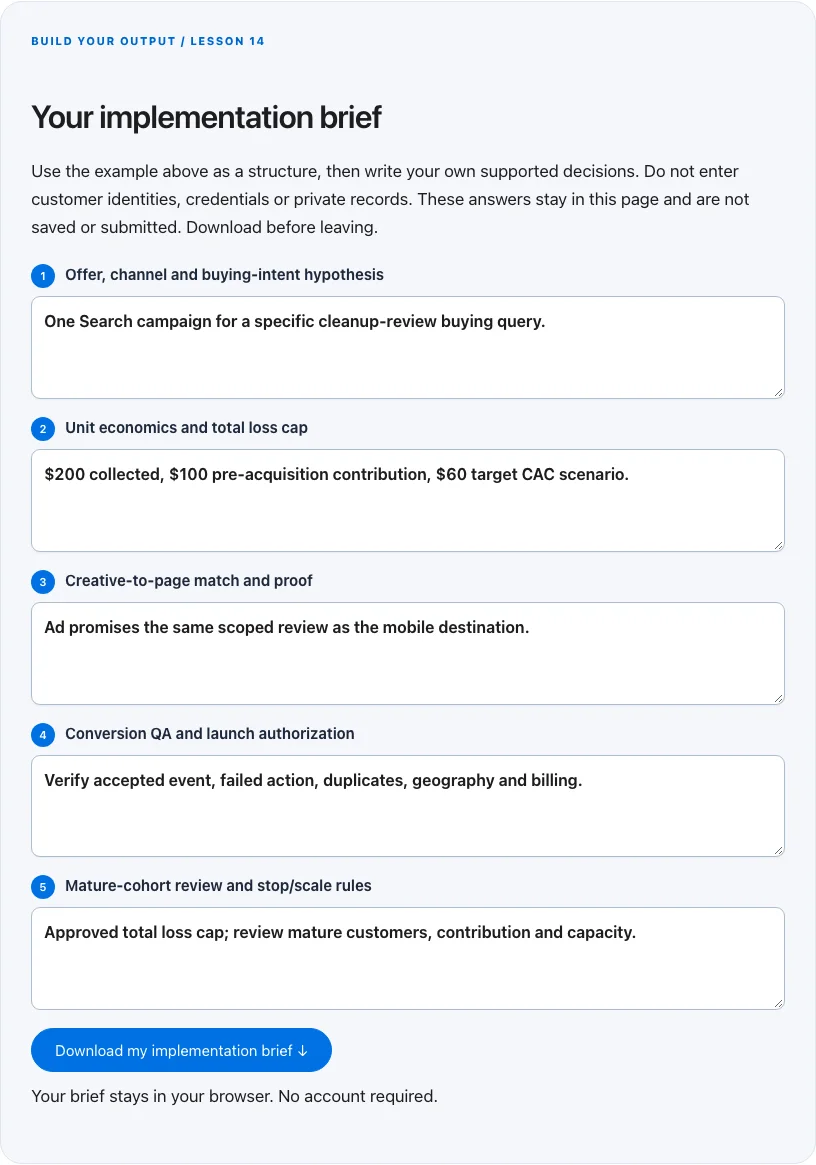
Troubleshoot before you add more tools
| What you notice | What to check next |
|---|---|
| Clicks are cheap but customers are expensive | Inspect qualification and close rates before celebrating CPC or expanding spend. |
| The platform reports conversions the CRM cannot find | Reconcile the event trigger and remove duplicate or proxy conversions. |
| Performance looks good but fulfillment is overwhelmed | Constrain acquisition to delivery capacity and review customer experience before scaling. |
BUILD YOUR OUTPUT / LESSON 14
Your implementation brief
Use the example above as a structure, then write your own supported decisions. Do not enter customer identities, credentials or private records. These answers stay in this page and are not saved or submitted. Download before leaving.
Your brief stays in your browser. No account required.
OPTIONAL TOOLS / CHOOSE FOR THE JOB
Tools that fit this lesson
Affiliate disclosure: I may earn a commission if you purchase through these affiliate links. You do not need to buy a tool to complete this lesson. These are fit-based options, not a claim that I personally use every product or that a product caused our companies’ results. Check current features, pricing and terms before buying.
GoHighLevel — explore the tool ↗
Consider a CRM-centered workflow when you need pipeline ownership and connected follow-up. Map the states first and test the relevant integrations. A simpler tool may be enough for a single page or sequence.
Replug — explore the tool ↗
An optional link-management tool for organized destinations and campaigns. Preserve issued affiliate parameters and test redirects. A maintained link spreadsheet and direct URLs can be sufficient.
Synthesys — explore the tool ↗
An AI voice/video option for a disclosed demonstration or explainer. Verify rights, identity permissions, captions and every claim. It is never a way to manufacture a testimonial; a real screen recording may be more useful.
Calilio — explore the tool ↗
A business-phone option when the workflow needs accountable calling or routing. Confirm geography, number availability, recording/privacy requirements and usage charges. A phone system is unnecessary for a purely self-serve digital task.
Free starting point: plan the workflow in a document or spreadsheet and test it using tools you already have. Buy a capability only when a verified constraint justifies it. Read the full affiliate disclosure.
Done means verified.
0 / 6 checkedCheck a line only when you have the evidence. A downloaded plan is a starting point; it does not prove that the live workflow works.
Verify all six checks to mark complete.
Review the evidence, then continue
Keep the output you created, the test date, the source of truth and the result of each completion check. Mark a system Live after the path is deployed and tested. Mark it Working only when adequate recent evidence meets a defined outcome target. If the lesson does not fit your business or stage, write the reason and a review trigger instead of pretending it is complete.
Choose one next action, assign an owner and set a review date. More tools, more traffic or more automation are not automatically the next step. The next lesson builds on this artifact, so resolve missing inputs or failed checks before expanding the system.
Go deeper when you need it
Primary references and further reading
Provider interfaces, limits and policies can change. Check the current official instructions for your account before implementing. This article teaches an operating method; it does not independently certify compliance or business performance.