Marketing Blueprint / Your course
Your Marketing Blueprint Course
Build it, verify it and connect the outputs into one working marketing system.
MODULE 01 OF 17
Offer Creation & Optimization
Build this: A priced offer ladder, unit-economics model and bounded validation plan.
Running business example: A deliverable a gym owner can buy
Fictional teaching business: Northstar Growth Studio. This is a small agency serving independent gyms. All prices, counts and outcomes in this example are hypothetical planning inputs, not Aaron’s company results.
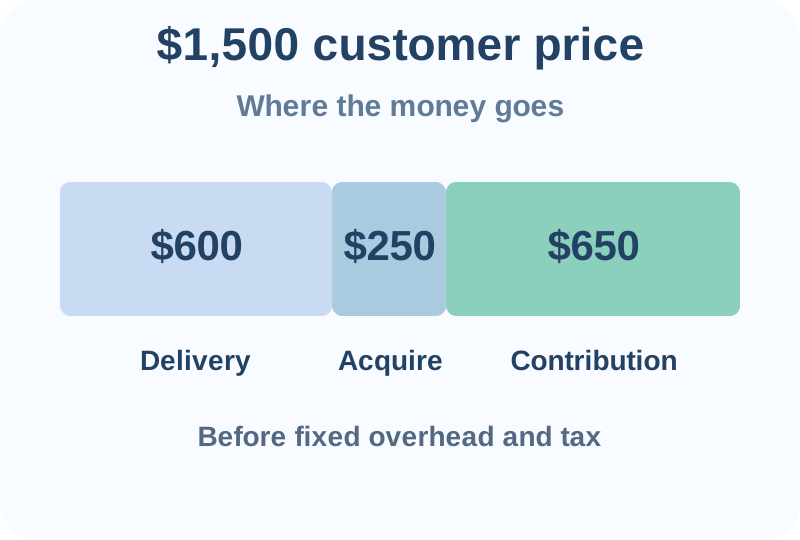
Northstar chooses independent gyms with an existing trial offer and a broken enquiry handoff. The core project is $1,500 with $600 modeled variable costs. Its output is a working page plus verified routing, not guaranteed memberships.
Output: A priced offer ladder, unit-economics model and bounded validation plan.
SUPPORTING IMPLEMENTATION GUIDE
Build this: A priced, deliverable offer with a documented customer, margin model and demand test.
An attractive website cannot fix an offer that nobody understands. Before choosing software, decide whose expensive problem you solve, what they receive, how the transaction works and whether you can deliver it. If you already have customers, optimize the existing offer before inventing another one. The output of this lesson is a one-page offer brief and a small test—not a new logo or a claim that demand has been proven.
Separate three questions: can the buyer explain the offer, will the buyer take a meaningful next step, and can you fulfill that promise at an acceptable contribution? A positive answer to one does not settle the others. Keep the evidence for each question separately.
Key takeaways
- Choose a buyer and a costly purchase situation before writing copy.
- Specify deliverable, boundaries, price and capacity together.
- Model contribution separately from revenue and personal income.
- Use a bounded demand test and preserve uncertainty.
Prerequisites and boundaries
Access to relevant customer conversations, a current offer and delivery-cost assumptions. No paid tool or new product launch is required.
- 01Choose one customer and one purchase situation
- 02Define the deliverable, boundaries and next action
- 03Price from delivery economics before acquisition
- 04Make the mechanism and proof specific
- 05Run a small demand test with a stop rule
- 06Review objections and change one constraint
Sell an outcome you can deliver
A price is only useful when the promise, cost and next step connect.
- 01
One buyer
Independent gym owner with missed trial enquiries.
- 02
One promise
A working trial page and enquiry handoff—not guaranteed memberships.
- 03
Check the margin
$1,500 price − $600 delivery − $250 acquisition = $650 contribution.
- 04
Test a commitment
Ask for a paid pilot with scope and acceptance criteria.
A vague service becomes a testable offer
“We do marketing for everyone.”
No clear buyer, deliverable or buying decision.
“A trial enquiry page + verified routing for independent gyms.”
Names the customer and the work you can actually deliver.
Complete a test enquiry and review the priced scope.
A working handoff proves the implementation; it does not prove demand.
Original instructional diagram. Fictional Northstar teaching examples; not company performance or a product screenshot.
BUILD STEP 01
Choose one customer and one purchase situation
Describe the buyer by the problem and buying context, not simply an age range. Write what has happened immediately before they start looking for help, what they currently use, who approves the purchase and what would make them defer. Interview existing customers about actual decisions rather than asking whether a hypothetical product sounds good. Preserve their wording without publishing identities. Exclude customers you cannot serve reliably; a narrow initial audience makes the page, sales conversation and delivery process easier to test.
Primary reference: SBA market-research guidance. Research the customer and alternatives before treating a generated offer as validated demand.
Verify before continuing A stranger can tell you who the offer serves, the trigger for buying and one clear exclusion.
BUILD STEP 02
Define the deliverable, boundaries and next action
Complete: We help [buyer] accomplish [specific task] through [deliverable]. Specify what arrives, in what format, within which delivery window and with which customer inputs. List exclusions and dependencies beside the promise. If results depend on advertising budget, implementation or third-party approval, say so. Choose a next action that matches the commitment: a scoped discovery call for complex services or a transparent checkout for a standardized purchase. A guarantee must match a policy you can actually honor.
Verify before continuing The headline, deliverable list and next-action label describe the same transaction.
BUILD STEP 03
Price from delivery economics before acquisition
Start with expected collected revenue net of discounts and refunds. Subtract product or delivery labor, payment fees, variable support and acquisition cost. Keep fixed overhead and taxes visible separately; contribution is not net profit. Count founder delivery time at an explicit cost so a low price does not conceal unpaid labor. For subscriptions, model first-period economics before assuming renewals. Write down which inputs are estimates and which come from reconciled payment or delivery records.
Verify before continuing Your contribution model uses one currency and identifies every assumption and excluded cost.
BUILD STEP 04
Make the mechanism and proof specific
Explain the sequence by which the deliverable helps the buyer. Replace best-in-class language with observable scope: an audit contains prioritized issues, screenshots and a review call. Attach evidence to the exact claim it supports. A founder award is background credibility, not proof that every customer will achieve the same result. Where you have no results yet, show a genuine sample deliverable, a transparent demonstration or a limited pilot with its limits stated.
Verify before continuing Every important claim has evidence or is explicitly framed as an unproven hypothesis.
BUILD STEP 05
Run a small demand test with a stop rule
Use a focused landing page and a legitimate source of relevant prospects. Define your maximum test spend or time, the minimum useful observation window and the action that counts as demand. A compliment or a page view is weaker evidence than a qualified conversation or a purchase. Record every stage: relevant visitors, accepted enquiries, qualified opportunities and customers. With low volume, use the conversations to identify objections rather than declaring a statistically significant winner.
Verify before continuing The test brief states its audience, channel, budget or time cap, outcome and review date before launch.
BUILD STEP 06
Review objections and change one constraint
Read lost-sale reasons alongside unit economics. No relevant visitors suggests distribution trouble; many relevant visitors but no enquiries suggests an unclear promise or weak fit; qualified conversations without purchases may expose price, trust or sales problems. Change the most supported explanation first. Preserve the previous version, dates and cohort so you can compare honestly. Mark the offer Live after the path works; call it Working only when a defined recent outcome target has adequate evidence.
Verify before continuing The next revision names one hypothesis, one change and the evidence that will decide whether to keep it.
Worked example: inputs → method → interpretation
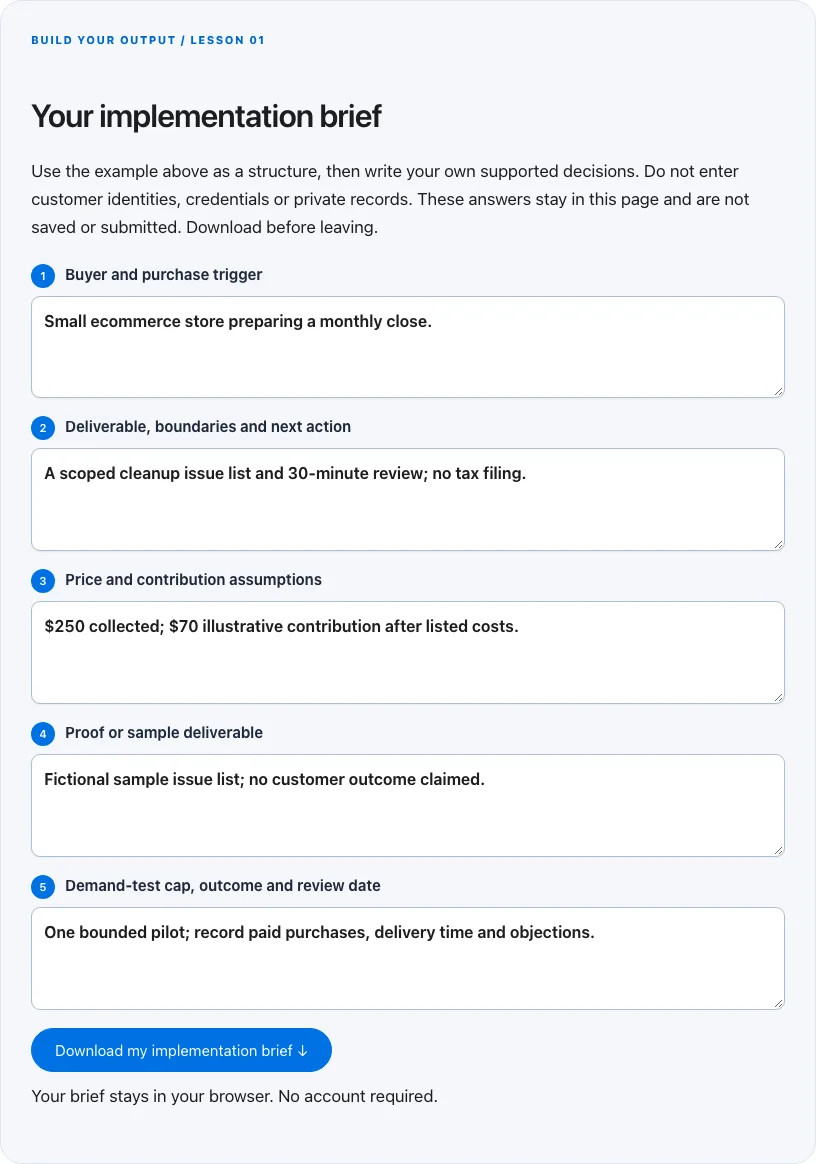
Fictional example: a bookkeeping consultant offers a $250 cleanup review for small ecommerce stores. The deliverable is a reconciled issue list and a 30-minute review, not a promise to recover a specific amount of tax. Assume $20 in expected refunds, $100 in delivery labor, $10 in fees and $50 in acquisition. Contribution is $250 − $20 − $100 − $10 − $50 = $70 before overhead and tax. If actual delivery takes twice as long, the economics change even if conversion improves. A useful pilot records paid purchases, delivery hours and objections from eligible stores. Ten people saying “interesting” does not establish willingness to pay.
Buyer: small ecommerce store with unreconciled monthly accounts
Trigger: owner needs a clean close before a lender review
Deliverable: issue list + scoped review call
Not included: tax filing, guaranteed savings, unlimited cleanup
Price: $250; estimated contribution after acquisition: $70
Evidence source: paid pilot orders and delivery-time log
Next test: one page, one relevant audience, one review date
This is an illustrative planning example. Replace assumptions with supported inputs and do not treat it as a result benchmark.
Common failure states and what to inspect
| Symptom | Next check |
|---|---|
| People misunderstand the offer | Ask five relevant readers to describe what arrives. Rewrite the deliverable before changing button colors. |
| Sales increase but cash gets tighter | Reconcile refunds, delivery time and payment timing; a growing negative-contribution offer needs correction. |
| The test has very little traffic | Do not label the offer a failure from a few views. Diagnose access to qualified prospects and record uncertainty. |
BUILD YOUR OUTPUT / LESSON 01
Your implementation brief
Use the example above as a structure, then write your own supported decisions. Do not enter customer identities, credentials or private records. These answers stay in this page and are not saved or submitted. Download before leaving.
Your brief stays in your browser. No account required.
Pressure-test the offer with three economic scenarios
Build a base case, a delivery-cost increase and a lower-conversion case. Keep collected revenue net of discounts and expected refunds separate from delivery labor, fees and acquisition. Count founder time at an explicit cost. Do not justify a first-order loss with renewals you have not observed.
For a fictional $250 service with $130 non-acquisition variable cost, contribution before acquisition is $120. Retaining $40 leaves an $80 acquisition allowance before fixed overhead and tax. If delivery cost rises by $50, that allowance falls to $30. These are scenario calculations, not market benchmarks or validated demand. Record each assumption and its evidence source.
Interview relevant buyers about their last real purchase or workaround. Then test one clear deliverable and commitment within an affordable time or spending cap. Compliments are weaker evidence than qualified actions, but even a purchase does not establish repeatable profitable acquisition. Track objections and actual fulfillment effort so the next revision fixes a supported constraint rather than changing every part of the offer.
Try the numbers. See what changes.
The prefilled numbers are fictional teaching inputs. Change them to explore a scenario; the output is not a forecast or a company result.
Your working result
Private to this page. Inputs are not sent or saved by this tool. Download a copy before leaving. Use invented or non-sensitive information on a shared device.
Cost, effort and when to keep it simple
Use a document and spreadsheet first. Include discovery, delivery time, support, refunds and test acquisition cost. A tool subscription cannot substitute for a specific offer.
What to maintain
Review after changes to customer fit, price, scope, costs, capacity or recurring objections. Keep old versions and dates so comparisons remain meaningful.
Implementation questions
Should I create a new offer or improve the current one?
Inspect the current customer’s problem, objections and delivery economics first. A new name or bundle is unnecessary if scope, clarity or fulfillment is the real issue.
Does a low test conversion rate prove nobody wants it?
Not by itself. Check qualified traffic, comprehension, trust, sample size and the actual commitment asked. Record what the evidence cannot establish.
Can I include a guarantee?
Only if it accurately describes a policy you can honor, with material conditions visible. Do not promise an outcome outside your control.
Is contribution the same as profit?
No. Contribution after acquisition still needs to cover fixed costs, taxes, financing and timing requirements.
Review and source scope
Editorial review: October 27, 2026. Examples labeled fictional are demonstrations, not company results. Primary references support specific instructions; they do not establish customer outcomes or certify compliance. Recheck current account controls and applicable requirements before a live change.
Refresh this article when the interface, source, offer, policy or recommended capability changes. Record the changed instruction and rerun the affected verification checks.
Optional tools for this task
Affiliate disclosure: I may earn a commission from eligible purchases through these links. Software is optional. Read the full disclosure.
Experience scope: these are researched options with approved, issued links—not a claim that every product was used in production at my companies. Features, current pricing and suitability need your own check. Affiliate approval is not product-use evidence.
Useful references and related implementation
Return to the seventeen-step course →
Keep a working copy
Use the prompts, example and verification checks in this downloadable Markdown resource. It is a plain-text working document, not a performance score.
Build an offer ladder that can actually be delivered
Start with a customer and a purchase situation. “Small businesses” is too broad to guide a promise. A gym owner with an existing ad budget and unreliable trial enquiries has a different problem from a first-time founder without a service. Write the last real incident, its cost, the current workaround and the buying trigger. Ask about past behavior before asking whether somebody likes your idea. Separate customer language from your interpretation.
Define the outcome without promising what you cannot control
Package the work around an observable change: a working trial-enquiry journey, accepted lead tracking and a team that knows how to respond. You can control the deliverables and verification. You cannot honestly guarantee a revenue lift from an untested traffic source. State who supplies assets, who approves copy, what constitutes completion and what is excluded.
Reduce practical effort and uncertainty: a clear intake checklist, a defined implementation window that reflects capacity, a sample deliverable and a handoff demonstration. These support value because the buyer can understand and use the outcome. Do not inflate a list with irrelevant bonuses or assign invented dollar values to ordinary tasks.
Price the whole delivery, not just your hours
List contractor work, transaction fees, tools attributable to the customer, support, revision capacity and a refund allowance. Distinguish contribution from company profit. Include the time between paying suppliers and collecting the customer’s money. An offer can show positive contribution while creating a cash shortfall.
| Offer | Customer pays | Variable cost | Contribution before acquisition and fixed overhead |
|---|---|---|---|
| Entry: funnel diagnostic | $250 | $100 | $150 |
| Core: landing-page launch | $1,500 | $600 | $900 |
| Optional upsell: CRM handoff setup | $750 | $300 | $450 |
| Recurring optimization/support | $300/month | $90/month | $210/month |
Method: contribution equals collected revenue less the stated variable delivery costs. The core project leaves $900 before acquisition and overhead. At an assumed $500 acquisition cost it leaves $400 before overhead, taxes, financing and owner compensation. That is a test constraint, not a reason to spend $500 automatically. Validate the cost assumptions and keep the acquisition period consistent.
Use entry offers, upsells and downsells for different needs
An entry diagnostic helps a buyer understand the problem before choosing implementation. If you credit the $250 diagnostic toward the $1,500 project, disclose the credit and model the combined transaction once: the buyer pays $1,500 total, not $1,750. Do not count both as full-price revenue.
An upsell should solve an adjacent problem the buyer actually has. The CRM setup belongs after a buyer needs a reliable handoff. Ask permission to discuss it, show the separate scope and price, and allow the core offer without the add-on. A downsell can reduce scope to a diagnostic or one page; it should not disguise the same work at a made-up lower price. Explain what is removed and what the buyer must do.
A recurring offer needs a recurring job: monitoring the accepted-lead path, handling defined updates and reviewing a useful metric. “Keep paying because growth takes time” is not a deliverable. Define cadence, included work, cancellation terms and the limits of support. Do not turn uncertain future retention into cash available today.
Make bonuses, guarantees and urgency honest
A relevant bonus might be a response checklist that helps the buyer use the delivered funnel. Include it when it reduces implementation friction. A guarantee must have clear eligibility, a remedy you can fulfill and a cost allowance. For example, a stated repair window for a broken implementation can fit the work you control. Do not promise a revenue outcome that depends on the buyer’s offer, budget and sales team.
Real capacity can create a real deadline: two implementation slots next month because two projects fit the delivery schedule. Record the capacity calculation and remove the message when the slots change. A resetting timer, invented “last chance” or false stock count undermines the evidence-led approach taught here.
Run a bounded offer test
- Choose one customer segment and interview about a recent incident.
- Show the deliverable, price, exclusions and next action in plain language.
- Record the objection in the buyer’s words. Separate price, timing, trust, fit and unclear scope.
- Ask for a meaningful next step appropriate to the stage. Interest is not a paid customer.
- Set a review date and a maximum affordable test cost before promoting the offer.
- Revise one assumption at a time and preserve the earlier version for comparison.
Completion: a stranger can explain who the offer serves, the work and price are deliverable, the economics use consistent inputs, the next test has a stop rule and every urgency/guarantee statement is true. Carry the approved offer into the AI brief and website modules.
Your implementation assignment
Use the offer ladder above to document scope, exclusions, price, capacity and the first customer interview.
- Write the input and its source. Mark assumptions explicitly.
- Build the module’s deliverable in your own workspace.
- Run an ordinary case and the relevant failure case.
- Record the evidence, remaining uncertainty and the next decision.
- Carry the verified output into the next module.
BEFORE YOU MOVE ON
Check the work. Keep the evidence.
Tick each item after you verify it in your own build. These checks are temporary; save the evidence in your worksheet.
Save the work. Then continue.
Download this module’s editable worksheet →Completion is your own record. If a step does not fit your business, record why and the condition that would make it relevant.
YOU HAVE YOUR OFFER. NOW BUILD THE SYSTEM.
Turn this first step into a working marketing system.
This is how I teach the systems behind our companies: clear steps, tools to implement them and checks to verify your work. Unlock the remaining 16 modules to connect your offer to a website, tracking, follow-up, customer acquisition, sales and delivery.
- Follow a clear build order — know what to work on next.
- Use the scripts and worksheets — apply each lesson to your own business.
- Verify your work — check the result before adding more tools or traffic.
UNLOCK MODULES 02–17
Keep going. The rest is free, too.
Get the complete written course, practical scripts and implementation worksheets. Confirm your email to unlock access. Nothing downloads automatically.